Last Tuesday, an Ottawa family discovered that their dream kitchen renovation was stalled by a positive test for chrysotile in their 1985 drywall mud. It's a common reality in the National Capital Region, where older builds often hide hazardous secrets. Finding certified asbestos removal contractors is the only way to ensure these fibers don't become airborne threats to your household. You want a home that's safe and a renovation that proceeds without legal or health-related delays.
We know you value craftsmanship and the peace of mind that comes from a job done right the first time. You deserve a partner who prioritizes meticulous containment over quick fixes. This guide outlines how to choose asbestos removal contractors who provide the clear documentation required for insurance and can protect your property's long-term value. We'll cover essential certification checks, the current standards for Ontario Regulation 278/05, and how to prepare your site for a transformative, worry-free remodel.
Key Takeaways
- Identify hidden risks in Ottawa’s post-war housing stock and understand the critical health differences between friable and non-friable hazardous materials.
- Decipher Ontario Regulation 278/05 to understand the three levels of abatement and which specific "Type" of operation your project demands for legal compliance.
- Learn the essential criteria for vetting professional asbestos removal contractors, including why standard liability insurance is insufficient without specific pollution riders.
- Budget effectively for 2026 by understanding the current local drivers for labor, testing, and C$ disposal fees at the City of Ottawa’s Trail Road facility.
- Discover the advantage of a seamless end-to-end process that transitions your home from hazardous remediation to a meticulous, high-quality renovation finish.
Understanding Asbestos in Ottawa Homes: Why Professional Abatement is Non-Negotiable
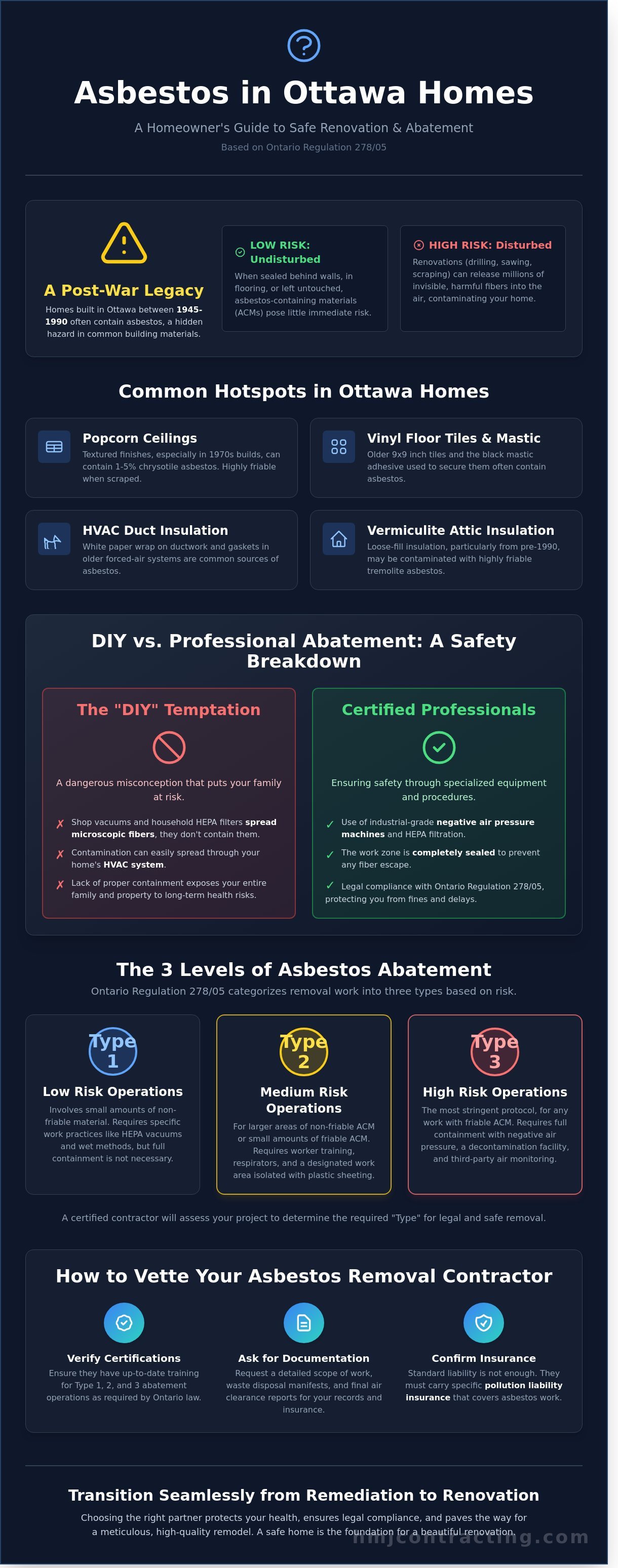
Ottawa’s post-war housing boom between 1945 and 1980 created thousands of beautiful homes, but it also left a hidden legacy of hazardous materials. Asbestos was a staple in Canadian construction for decades due to its fire resistance and insulating properties. In neighborhoods like Nepean and Kanata, many residences built before 1990 still contain these minerals within their structural bones. Understanding the dangers of asbestos fibres is the first step in any responsible home improvement project. When these materials remain undisturbed, they pose little risk; however, a single hammer swing during a basement remodel can release millions of invisible particles into your living space.
The legal landscape in Ontario is clear. Ontario Regulation 278/05 governs the management of asbestos in buildings and on construction projects. This regulation mandates specific testing and handling procedures that go far beyond standard demolition practices. Hiring certified asbestos removal contractors isn't just a safety choice. It's a regulatory requirement designed to prevent the spread of toxins into the community. Failure to follow these protocols can lead to stop-work orders from the Ministry of Labour, which can delay your project by several weeks and result in significant fines. Your home's safety depends on doing things right the first time.
Common Asbestos-Containing Materials (ACMs) in the National Capital Region
In Ottawa’s 1970s-era builds, popcorn ceilings and heavy textured finishes are the most frequent culprits. These finishes often contain 1% to 5% chrysotile asbestos, which becomes airborne easily during scraping. Homeowners should stay alert for these common hotspots:
- Popcorn Ceilings: Textured finishes common in 1970s bungalows and split-levels.
- Floor Tiles: 9x9 inch vinyl tiles and the black mastic adhesives found in older basements.
- HVAC Insulation: White corrugated paper wrap on ductwork and grey register gaskets from 1950s forced-air systems.
- Vermiculite: Loose-fill attic insulation that may contain tremolite asbestos, common in pre-1990 builds.
These materials are often in a degraded state, making them highly volatile if bumped or moved during a routine renovation. Our team treats every vintage material with the meticulous care it deserves to ensure no fibres escape the work zone.
The Danger of the "DIY" Temptation
It's tempting to think a hardware store dust mask and a shop vacuum can handle a small renovation. This is a dangerous misconception. Standard vacuum filters cannot trap microscopic asbestos fibres; instead, they blast them out the exhaust, spreading contamination throughout your entire house. Household HEPA filters often lack the seal integrity required to prevent bypass, meaning they catch some dust while circulating the most dangerous, invisible fibres. One wrong move can pull these fibres into your HVAC system, distributing them to every bedroom in the home.
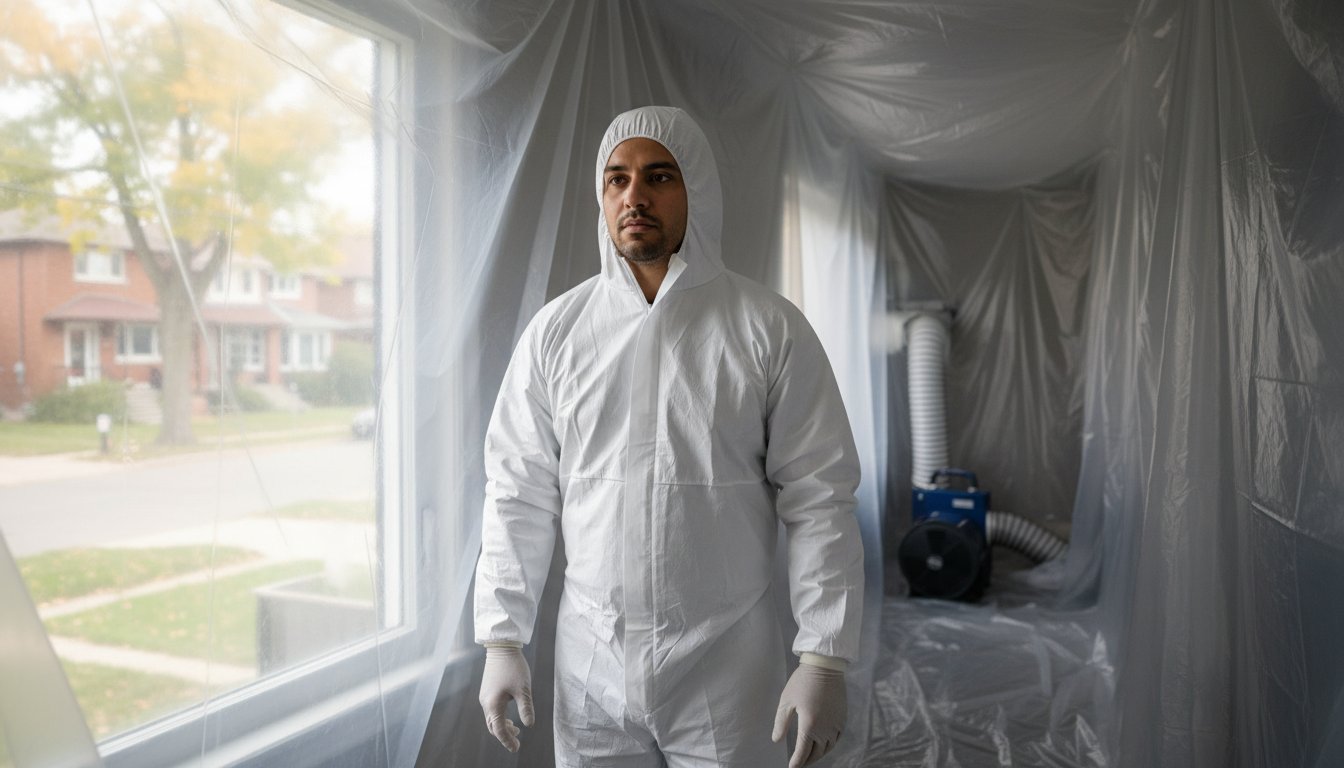
Professional asbestos removal contractors use industrial-grade HEPA filtration and negative air pressure machines to ensure the work zone remains completely sealed. Friability refers to a material's tendency to crumble under hand pressure, a characteristic that will continue to dictate strict air quality protocols for Ottawa residential renovations throughout 2026. Don't risk your family's health for a weekend project. We provide the technical expertise and specialized equipment needed to clear your home of these risks safely, providing the peace of mind that comes with a job done to the highest professional standards.
The 3 Levels of Asbestos Abatement: What to Expect During the Removal Process
In Ontario, the safety of your home during a renovation depends on strict adherence to Ontario Regulation 278/05. This regulation dictates exactly how asbestos removal contractors must handle hazardous materials based on the risk of fiber release. Professional teams don't decide these protocols on a whim; they categorize every project into one of three "Types" to ensure the air remains clean. Understanding these levels helps you visualize the meticulous care required to protect your family's health.
Contractors determine the operation type by assessing the material's friability and the total surface area involved. Friable materials, like old pipe insulation, crumble easily under hand pressure and pose the highest risk. Non-friable materials, such as vinyl floor tiles, are more stable but still require professional handling. Following Canada's asbestos regulations ensures that every particle is contained; this prevents the long-term respiratory issues associated with exposure.
The equipment used during these stages is highly specialized. Asbestos removal contractors rely on HEPA (High-Efficiency Particulate Air) filtration systems that capture 99.97% of particles as small as 0.3 microns. In higher-risk scenarios, negative air pressure machines are installed to create a vacuum effect. This ensures that if a seal in the containment area breaks, air flows into the workspace rather than leaking hazardous dust into the rest of your house.
Type 1 and Type 2 Operations: Small to Medium Scale
Type 1 operations involve non-friable materials like vinyl floor tiles where dust risk is low. Technicians use hand sprayers to keep materials wet and use 6-mil polyethylene drop cloths. Type 2 applies to small areas of friable material or drywall joint compound. Here, contractors use HEPA-filtered vacuums and build mini-enclosures. This level of precision is why homeowners choose expert renovation partners who prioritize safety.
Type 3 Operations: High-Risk Large Scale Removals
Type 3 is mandatory for removing over 1 square meter of friable insulation or popcorn ceilings. These projects require a "Notice of Project" filed with the Ministry of Labour 24 hours in advance. Crews build full-scale enclosures with negative air pressure and three-stage decontamination showers. This 100% containment strategy ensures no fibers escape, protecting the rest of your Ottawa home during the process.
The final step for high-risk projects involves third-party air testing and a formal clearance certificate. An independent laboratory must verify that fiber levels are below 0.01 fibers per cubic centimeter before the plastic barriers are removed. This provides documented proof that the work area is safe for re-entry. By insisting on these rigorous standards, you ensure that your home's transformation is built on a foundation of safety and integrity.
How to Vette Asbestos Removal Contractors in Ottawa: Beyond the Lowest Quote
Selecting a partner for hazardous material remediation isn't the same as hiring a painter or a floor installer. In the Ottawa construction market, price shopping often leads to dangerous shortcuts. While a low bid might look attractive on a balance sheet, it frequently indicates a lack of specialized equipment or proper licensing. Professional asbestos removal contractors prioritize containment and long term safety over speed. They understand that disturbing even a small patch of popcorn ceiling or floor tile can release thousands of invisible fibers into your home's air supply.
Hiring general laborers for this work is a significant gamble. These workers often lack the rigorous training required to manage Type 2 or Type 3 removals as defined by Ontario Regulation 278/05. Using a shop-vac or a standard dust mask is a recipe for disaster. Medical data from the World Health Organization confirms there is no safe level of asbestos exposure, which makes professional abatement a necessity rather than an option. A seasoned expert treats your home like a laboratory, not a demolition site.
Insurance is the next critical hurdle. A standard general liability policy usually excludes pollution and asbestos related claims. If an untrained contractor contaminates your neighbor's property or your HVAC system, their basic insurance won't cover the C$20,000 to C$50,000 cleanup cost. You must demand proof of a specific pollution occurrence or asbestos rider. Furthermore, look for a firm with 25 years of local experience in the Ottawa valley. Contractors who have worked in neighborhoods like Westboro or the Glebe for decades understand the specific building materials used in 1940s wartime houses and 1970s suburban developments.
Finally, ask about the paper trail. Every gram of hazardous waste must be tracked. Professional asbestos removal contractors provide a waste manifest that proves the material reached a licensed Ontario landfill. They don't just dump bags in a residential bin. This documentation protects you from future legal liability and is essential when you eventually sell your property.
Essential Certifications and Paperwork
Verify that the company holds valid WSIB clearance and specialized environmental insurance with at least C$5 million in coverage. Every technician on your site should possess up to date certificates for asbestos awareness and high risk handling. Never start a project without a detailed written Scope of Work. Once the job finishes, insist on a formal Closure Report that includes third party air clearance results to prove the space is safe for re-entry.
This training extends to the correct use of personal protective equipment, such as N95 respirators, which require professional fit-testing to be effective. For a look at what these WSIB-approved certification courses involve, check out Aspire First Aid Guide Training Corp.
Red Flags in an Asbestos Removal Estimate
Be wary of quotes that fall 30% or more below the Ottawa market average of C$25 to C$50 per square foot for standard removals. If a contractor suggests simply "covering up" friable asbestos without proper encapsulation, walk away. A legitimate estimate always includes line items for HEPA filtration, negative air pressure machines, and independent air monitoring. If these technical steps are missing from the quote, the contractor is likely cutting corners on your health.
Navigating Ottawa’s Asbestos Regulations and Disposal Costs in 2026
Hiring professional asbestos removal contractors in Ottawa involves more than just clearing a schedule; it requires a clear understanding of the current financial and regulatory climate. In 2026, labor costs for hazardous material technicians have stabilized after a 5.8% increase over the last two years. Specialized disposal fees at the Trail Road Waste Facility now include a mandatory C$225 per tonne surcharge for asbestos-containing materials (ACMs). Testing costs also remain a factor. A standard bulk sample analysis for a residential property currently averages C$375 for a three-sample set, which is the minimum required to establish a baseline for safe removal.
The timeline for a typical residential abatement project in Ottawa generally spans three to seven business days. This window accounts for site preparation, the actual removal, and the mandatory 24-hour waiting period for air clearance testing. If you're planning a larger renovation, these steps must integrate with your building permit application. The City of Ottawa requires a completed Designated Substance Survey (DSS) for any structural alterations in homes built before 1990. Without this document, permit approvals will stall, potentially delaying your project by several weeks.
Estimated Costs for Common Removal Projects
Budgeting for asbestos removal depends heavily on the "Type" of operation defined by Ontario Regulation 278/05. Low-risk Type 1 projects, such as removing a few asbestos-containing floor tiles or a single register gasket, typically cost between C$600 and C$1,400. In contrast, full attic vermiculite remediation is a high-risk Type 3 operation. This requires full negative pressure enclosures and decontamination units, often resulting in invoices ranging from C$9,500 to C$16,000 depending on the attic's accessibility. As of April 2026, the average cost for professional popcorn ceiling removal in Ontario ranges from C$9.75 to C$15.25 per square foot, reflecting the intensive labor required for safe containment and HEPA filtration.
- Type 1 (Low Risk): Vinyl flooring, gaskets, or small sections of drywall.
- Type 2 (Medium Risk): Pipe insulation, larger drywall areas, or ceiling tiles.
- Type 3 (High Risk): Vermiculite, structural fireproofing, or extensive friable materials.
Local Disposal and Environmental Compliance
Safe disposal is a legal mandate that protects the Ottawa community. Every project we manage includes a formal Waste Manifest. This document tracks the ACMs from the moment they leave your driveway until they're processed at a licensed landfill. Ottawa-specific bylaws are strict regarding the transport of hazardous materials; trailers must be leak-proof and double-lined with 6-mil polyethylene bags. HMJ Contracting prioritizes transparent disposal records for every client because we believe accountability is the foundation of craftsmanship. We provide you with copies of all tipping receipts and manifests to ensure your property's environmental record is spotless.
Choosing the right team means choosing peace of mind. Our meticulous approach ensures that your home isn't just clean, but compliant with every provincial and municipal standard. If you're ready to clear the way for your next home transformation, we're here to lead the way.
Secure your home’s future with a partner you can trust. Contact HMJ Contracting today for a detailed consultation on your abatement needs.
From Remediation to Renovation: Why HMJ Contracting is Ottawa’s Trusted Choice
HMJ Contracting isn't just a remediation company. We've spent over 25 years serving the Ottawa region, including growing hubs like Kanata and Nepean. Since our founding in 1999, we've focused on a complete lifecycle approach to home safety. Most asbestos removal contractors specialize in demolition alone. They leave you with a safe but gutted room and a long list of new trades to call. We eliminate that gap. Our team manages the entire transition from hazardous material removal to the final coat of paint on a custom kitchen or the last board of a new deck.
Managing a renovation is hard enough without the added fear of hazardous materials. We act as your single point of contact for the entire project. This eliminates the 15% to 20% markup often found when homeowners hire separate remediation and construction firms. You won't have to coordinate schedules between a demo crew and a carpenter. We handle the logistics so your project stays on track and within your C$ budget. Our process ensures that the safety standards required for asbestos handling flow directly into the high-end craftsmanship of your renovation.
- One team handles the hazardous waste disposal and the structural rebuild.
- Dedicated project managers oversee every phase with 25 years of local expertise.
- Specific knowledge of Ottawa’s older housing stock in areas like Westboro and Nepean.
- Transparent pricing with no hidden fees between the demolition and the finish.
A Holistic Approach to Home Improvement
Hiring a specialist who understands both abatement and construction saves you more than just money; it saves your design. When we identify asbestos in a load-bearing wall, we don't just stop. We provide the structural solutions to safely remove the hazard while preparing the space for your new vision. This "Quality Without Compromise" philosophy means we never cut corners on safety or aesthetics. We've completed hundreds of projects across the capital region, ensuring every home is both healthy and beautiful.
We coordinate every removal with your long-term goals in mind. If you're planning a kitchen overhaul but find asbestos tiling, we treat that discovery as step one of your renovation rather than a project-ending disaster. Our asbestos removal contractors work alongside our master carpenters to ensure the transition is seamless. You get a home that isn't just free of toxins, but is also a bespoke reflection of your lifestyle.
Start Your Stress-Free Transformation Today
Trust is built through transparency and meticulous craftsmanship. We provide detailed site assessments that outline exactly what needs to go and how we plan to replace it. Our communication is direct and honest. We won't hide behind technical jargon. Instead, we offer clear timelines and fixed quotes so you can plan your life with confidence. We treat your home with the respect it deserves, maintaining a clean and secure worksite from start to finish.
Your home is likely your largest investment. Don't leave it in the hands of someone who only knows how to tear things down. Choose a partner who values the history of your Ottawa home while building its future. We're ready to help you navigate the complexities of remediation and the excitement of remodeling with ease. Bring your vision to life with HMJ Contracting and experience the peace of mind that comes from working with Ottawa's premier full-service experts.
Secure Your Ottawa Property’s Future Today
Managing hazardous materials in 2026 requires more than just caution; it demands a partner who understands the specific regulatory landscape of Ontario. Identifying qualified asbestos removal contractors is the first step in ensuring your family's safety and your property's long-term value. You've learned that the lowest quote often misses the critical safety protocols required for complex Type 3 abatement. Professional remediation isn't a place to cut corners when your health is on the line.
At HMJ Contracting, we bring over 25 years of local contracting experience to every project. We don't just clear the air; we rebuild your vision. As certified hazardous material remediation experts, our team manages the entire lifecycle of your project. We provide a seamless transition from meticulous demolition to high-end, bespoke renovations. This end-to-end approach eliminates the stress of managing multiple subcontractors and guarantees a result built to last for generations.
Your home deserves a standard of craftsmanship that doesn't compromise on safety or aesthetics. Let's ensure your next renovation starts on a clean, secure foundation. Book Your Professional Asbestos Assessment in Ottawa to get started with a team that values your peace of mind as much as you do. We're ready to help you move forward with confidence.
Frequently Asked Questions
Can I stay in my home while asbestos removal contractors are working?
You can stay in your home during minor Type 1 removals, but we recommend vacating for larger Type 2 or Type 3 projects. Professional asbestos removal contractors use negative air pressure machines and sealed polyethylene barriers to isolate the work zone from the rest of the house. For a standard 1,000 square foot basement project, staying upstairs is technically possible; however, 85% of Ottawa families choose to leave for 48 hours to ensure complete peace of mind.
How much does asbestos removal typically cost in Ottawa for a standard basement?
Asbestos removal typically costs between C$3,000 and C$8,000 for a standard 800 square foot Ottawa basement. These figures fluctuate based on the material type, such as vinyl floor tiles or parging, and the required containment level. A full Type 3 abatement for a 1,200 square foot space with extensive pipe insulation can reach C$15,000. We provide meticulous quotes that reflect the specific scope and safety requirements of your bespoke renovation.
Is a building permit required for asbestos abatement in Ontario?
You don't need a building permit specifically for the act of asbestos abatement in Ontario, though all work must follow O. Reg. 278/05 safety protocols. However, the structural renovations that often follow the removal usually require a permit from the City of Ottawa. We handle the technical compliance for the removal phase and can guide you through the 10 day Notice of Project required by the Ministry of Labour for high-risk work.
What is the difference between an asbestos removal contractor and an abatement company?
A specialized abatement company focuses strictly on the safe extraction and disposal of hazardous materials. In contrast, full-service asbestos removal contractors manage the entire lifecycle of your project, from initial testing to the final reconstruction and finishing. Choosing a partner who understands both the safety requirements and the structural vision ensures a seamless transition from a hazardous site to a beautiful, transformed space.
What happens if asbestos is found during a renovation that has already started?
You must stop all work immediately if you suspect asbestos has been disturbed during an active renovation. Seal the affected room with 6-mil poly sheeting and turn off your HVAC system to prevent fiber migration through the ductwork. Once the site is secure, we dispatch a technician to collect samples for 24 hour lab analysis. This proactive approach prevents cross-contamination in the remaining 95% of your living space.
How do I know if the air is safe after the asbestos has been removed?
We verify air safety through mandatory third-party air clearance testing once the work area is clean. For Type 3 projects, an independent technician uses high-volume air pumps to collect samples that a laboratory analyzes under Phase Contrast Microscopy. The air is only deemed safe when fiber levels fall below the provincial limit of 0.01 fibers per cubic centimeter. This scientific verification provides the ultimate assurance for your family's health.
Does home insurance in Ontario cover the cost of asbestos removal?
Standard home insurance policies in Ontario rarely cover the cost of removing asbestos because it's considered a maintenance or environmental issue. Approximately 98% of policies exclude hazardous material abatement unless the asbestos was disturbed by a covered peril, like a sudden pipe burst or fire. We recommend reviewing your specific policy's "Pollution" or "Hazardous Materials" clause to see if your 2024 coverage includes any specific riders or exceptions.