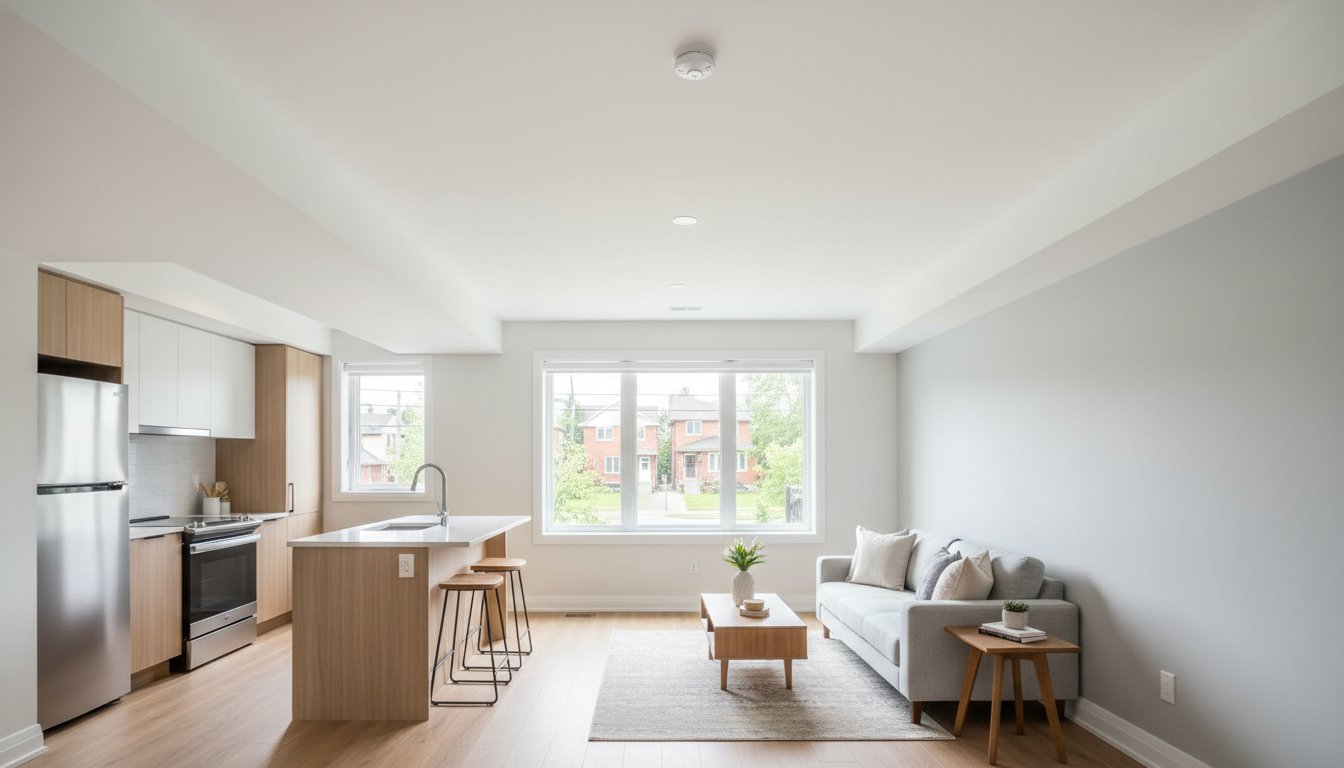
A single non-compliant stair riser or an overlooked fire separation can turn your C$85,000 renovation into a mandatory decommissioning order from the City of Ottawa. It's a harsh reality for homeowners who prioritize aesthetics over the strict Ontario Building Code. You likely recognize that adding a secondary suite is the most effective way to combat 2026's high interest rates, yet the technical divide between a finished room and a legal dwelling remains a source of stress. Mastering the specific legal basement apartment requirements Ottawa inspectors demand is the only way to protect your investment and your future tenants.
We provide a definitive roadmap through the latest zoning bylaws and safety regulations to ensure your peace of mind. You'll learn exactly how to transform your underutilized space into a high-end, compliant rental unit that passes every inspection with ease. This guide covers everything from ceiling height minimums to egress window dimensions, giving you the confidence to build a bespoke space that increases your property value without the fear of city fines.
Key Takeaways
- Understand the specific criteria that define a legal secondary dwelling unit in Ottawa, ensuring your rental is fully self-contained and compliant.
- Master the essential legal basement apartment requirements Ottawa homeowners must follow, including mandatory Ontario Building Code standards for ceiling heights and egress windows.
- Learn how to identify and mitigate hidden safety risks like asbestos and moisture common in older Ottawa properties to protect your investment and your tenants.
- Navigate the City of Ottawa permit process with confidence by following a structured path from BCIN-certified drawings to final occupancy.
- Discover the value of a professional, full-service partnership to manage the complex transition from a vision to a high-quality, income-generating reality.
What Defines a Legal Basement Apartment in Ottawa?
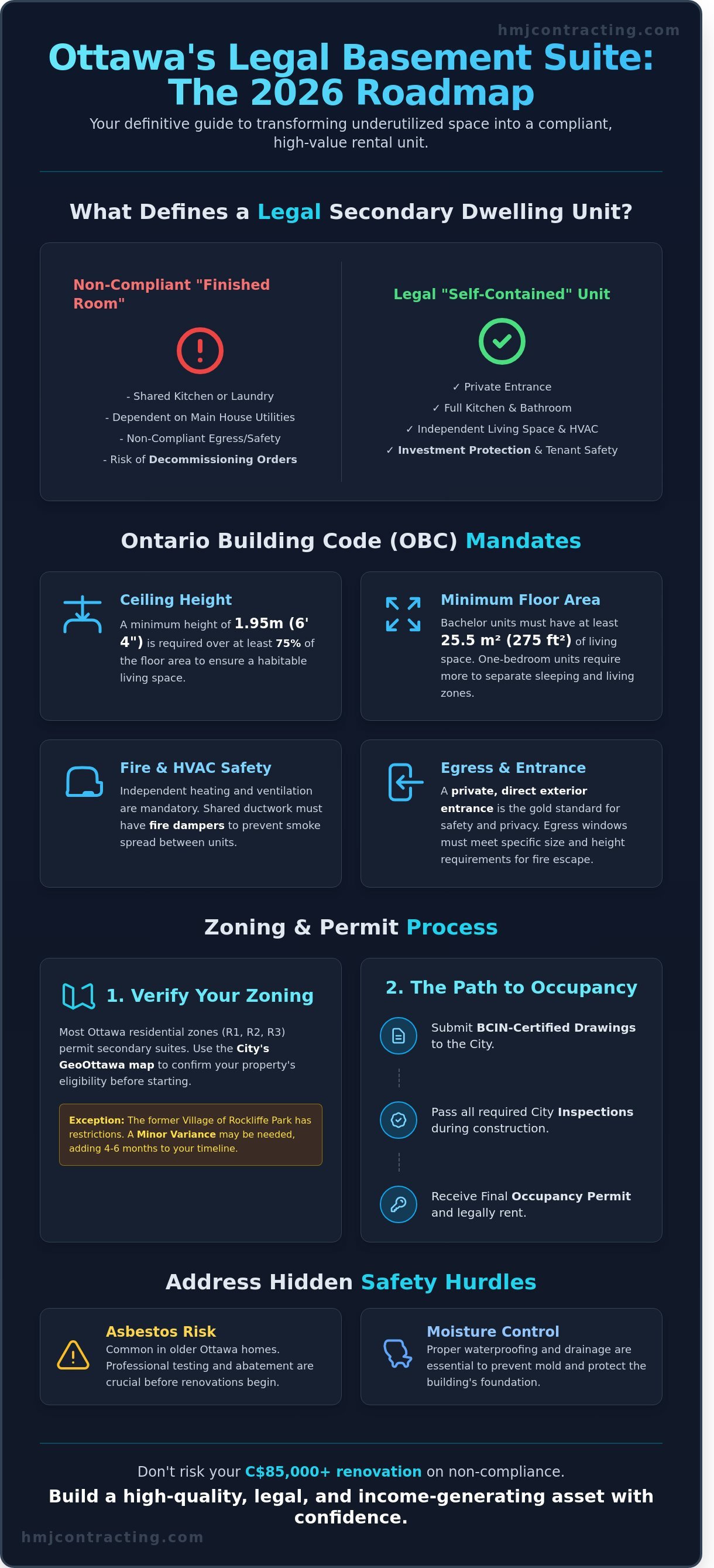
Ottawa's housing market demands creative solutions for density and affordability. A legal basement apartment, officially known as a secondary dwelling unit, is a self-contained residence located within a primary home. Since 2005, Ottawa by-laws have permitted these units in most residential zones to help address the city's 2.1% vacancy rate and increase housing density. Understanding the legal basement apartment requirements Ottawa homeowners must follow is the first step toward a successful investment. There's a major distinction between a casual in-law suite and a legal rental unit. An in-law suite might share a laundry room or a kitchen with the main house. A legal unit requires its own private entrance, full kitchen, bathroom, and dedicated living space to meet provincial and municipal standards. What Defines a Legal Basement Apartment in Ottawa? It's a space that functions entirely on its own, providing a safe and private environment for a tenant while protecting the owner's liability.
Building a legal suite is a meticulous process. You can't just throw up some drywall and call it a rental. HMJ Contracting approaches these projects with technical authority, ensuring every square inch meets the Ontario Building Code. We focus on craftsmanship that lasts for generations, transforming a dark basement into a bespoke living space. This conversion isn't just about extra income; it's about adding long-term value to your property through a professional, seamless renovation.
Ottawa Zoning By-laws and Neighbourhood Restrictions
Most residential zones in Ottawa allow secondary suites, but exceptions exist. You must verify your property's specific status before you invest in architectural drawings. The former Village of Rockliffe Park remains a notable exception, where strict heritage and density restrictions often prohibit these units. To find your specific designation, use the City of Ottawa GeoOttawa map. This tool allows you to input your address and view your zoning code, such as R1, R2, or R3. If your property has a restrictive overlay, you'll need to apply for a minor variance from the Committee of Adjustment. This process can add four to six months to your timeline, so early verification is vital for a stress-free experience.
The "Self-Contained" Requirement Explained
True independence is the core of a legal suite. You don't want your tenant's comfort to depend on your thermostat settings. Current 2026 standards require independent heating and ventilation controls for the basement unit. This ensures fire safety and proper air exchange. Shared laundry or shared entrances can complicate your legal status. While a shared entrance is technically possible if it leads to a common vestibule, a private, direct exterior entrance is the gold standard for privacy and resale value. Legal basement apartment requirements Ottawa inspectors look for include specific square footage minimums. For a bachelor unit, you need at least 25.5 square metres (about 275 square feet) of living space. A one-bedroom unit requires more room to ensure the sleeping area is properly separated from the kitchen and living zones. We ensure these measurements are exact, avoiding costly mid-project corrections.
- Private Entrance: Must provide a safe exit path directly to the outside.
- HVAC: Independent ductwork or fire dampers are mandatory to prevent smoke spread.
- Ceiling Height: A minimum height of 1.95 metres (6' 4") over at least 75% of the floor area.
- Kitchen Facilities: Must include a sink, stove, and fridge with dedicated electrical circuits.
Our team handles these logistical hurdles with composure. We believe in quality without compromise, ensuring your secondary suite is a stable, reliable asset. By following these strict guidelines, you protect your investment and provide a high-quality home for a fellow Ottawan.
Essential Ontario Building Code (OBC) Requirements
Meeting the legal basement apartment requirements Ottawa homeowners must follow starts with the Ontario Building Code (OBC). This document ensures every secondary suite is safe, habitable, and durable. You can find the full Essential Ontario Building Code (OBC) Requirements through the provincial portal, but we've distilled the most critical structural mandates here for your 2026 project. These rules aren't just red tape; they're the blueprint for a high-quality living space that protects your investment and your tenants.
Ceiling height is often the first hurdle in older Ottawa neighborhoods like Westboro or Glebe. The OBC requires a minimum height of 1950mm (6’ 5”) over at least 75% of the required floor area. You can have minor obstructions like ducts or beams that drop to 1800mm (5’ 11”), but these cannot interfere with the natural path of travel. If your basement currently sits at 6 feet, you'll likely need to consider a basement blowout or underpinning to reach compliance. This process adds significant value but requires professional structural oversight.
Egress windows provide a secondary escape route and are non-negotiable. Each bedroom must have at least one window that can be opened from the inside without tools. This window must provide an unobstructed opening of at least 0.35 square metres (3.8 square feet), with no dimension less than 380mm (15 inches). If the window opens into a window well, the well must extend at least 900mm (35 inches) from the wall to allow a person to climb out safely during an emergency.
Fire separation and sound transmission go hand-in-hand for tenant comfort. You must provide a fire-resistance rating of at least 30 minutes between the basement suite and the main house if the building is over five years old. For newer homes, or specific structural layouts, a 45-minute rating is often required. We achieve this by using 5/8-inch Type X drywall and fire-rated caulking at all penetrations. Additionally, the OBC mandates a Sound Transmission Class (STC) rating of 50. This ensures that footsteps from the floor above don't disrupt the peace of the unit below.
Fire Safety and Emergency Exits
Safety systems must be integrated throughout the entire property. All smoke alarms must be interconnected; if a sensor detects smoke in the basement kitchen, every alarm in the house sounds simultaneously. You must also install carbon monoxide detectors within 5 metres (16 feet) of every sleeping area. Your exit path must lead directly to the exterior. It cannot pass through a shared furnace room or another dwelling unit, ensuring a clear, safe route out of the home at all times.
Plumbing and Electrical Standards
Electrical safety is verified by the Electrical Safety Authority (ESA), which operates independently of your municipal building permit. We ensure your suite has its own panel or sufficient circuit capacity for modern appliances. Because Ottawa sits on heavy clay soil, the OBC requires the installation of a backwater valve. This device prevents sewage from backing up into the basement during heavy rainstorms or rapid snowmelt. Finally, stairs and hallways must have permanent lighting with a minimum of 50 lux to ensure safe movement between rooms. Our team provides meticulous basement conversions that manage these technical details from the first permit to the final inspection.
These plumbing requirements are critical, as cutting into concrete slabs or altering existing drain lines can lead to unexpected complications. Whether you're in Ottawa or elsewhere, a renovation can quickly turn into a crisis if a pipe bursts or a drain fails. Having a reliable contact, like an emergency plumber Richmond BC, is a key part of any homeowner's toolkit, even for planned projects.
Addressing Asbestos and Moisture: The Hidden Safety Hurdles
Building a secondary suite in Ottawa isn't just about aesthetics. It's about safety and longevity. Many homes in established neighborhoods like Carlington, Westboro, or Nepean were built before 1990. These properties often hide legacy materials that can derail a project if they aren't handled correctly. Meeting the legal basement apartment requirements Ottawa enforces starts with a clean slate. We don't build over problems; we solve them first. You won't find us taking shortcuts that compromise the air quality of your home.
Asbestos Remediation in Basement Renovation
Asbestos remains a common find in Ottawa’s older housing stock. It typically appears in 9x9 vinyl floor tiles, duct wrap, or older ceiling textures. If your home dates back to the mid-1980s or earlier, there's a 75% chance some form of asbestos exists in the basement. Under the Ontario Occupational Health and Safety Act, homeowners must conduct a Designated Substance Survey (DSS) before starting renovations. This isn't a suggestion; it's a legal mandate. Our team coordinates professional testing to identify these risks early. Certified abatement ensures your property remains safe for your family and your future tenants. Skipping this step can lead to C$50,000 fines or long-term health liabilities that far outweigh the cost of proper removal.
Moisture Control and Foundation Integrity
Ottawa’s climate is harsh on foundations. With annual temperature fluctuations spanning 60 degrees, concrete walls naturally develop hairline cracks over time. Installing drywall over an unsealed foundation is a major mistake. Moisture trapped behind finished walls leads to toxic mold growth in as little as 48 hours. This destroys your investment and makes the unit uninhabitable. To meet the legal basement apartment requirements Ottawa inspectors look for, we prioritize foundation health. This includes:
- Crack Injection: We use high-pressure polyurethane injections to seal foundation leaks from the inside out.
- Exterior Waterproofing: For severe cases, we install dimpled membranes and new weeping tiles to divert water away from the footings.
- Thermal Protection: We use R-22 Roxul or rigid foam insulation. This prevents the "dew point" from forming inside your walls, which stops condensation in its tracks.
HMJ Contracting takes a proactive stance on demolition. We strip spaces back to the bare concrete to inspect every square inch. We've seen how a small damp spot in April becomes a flooded basement by the June rain season. Our 20-point moisture assessment ensures your renovation rests on a dry, stable foundation. We provide the technical expertise to handle these hidden hurdles, giving you total peace of mind that your suite is built to last for decades. We don't just build walls; we build a protective envelope for your investment.
The Ottawa Permit Process: From Application to Occupancy
The journey to a secondary dwelling unit begins with paperwork, but it ends with peace of mind. To meet the legal basement apartment requirements Ottawa enforces in 2026, you must follow a methodical four-step sequence. This isn't just bureaucracy; it's a safety framework designed to protect your investment and your future tenants.
First, you secure professional drawings with a BCIN. Second, you submit these plans to the City of Ottawa Building Code Services. Third, you must pass mandatory inspections at key construction milestones. Finally, you receive your Occupancy Permit and register the unit with the city. Skipping any of these steps creates legal liabilities that can cost homeowners upwards of C$25,000 in remedial work or fines.
Why Your Contractor Needs a BCIN
A Building Code Identification Number (BCIN) is a legal requirement for designers in Ontario. It proves the person drafting your plans has passed provincial exams on the Ontario Building Code. When we submit BCIN-certified drawings, the City of Ottawa typically completes its initial review within 10 to 15 business days. Unlicensed designers often produce plans that lack specific fire-rating details or structural calculations, leading to immediate rejection. Using a BCIN-qualified professional ensures your project moves from the drawing board to the job site without costly revisions or administrative delays.
Navigating City Inspections
City inspectors visit your home at least three times during construction. The "open wall" inspection is the most critical phase. During this visit, the inspector verifies the structural integrity of the framing, the rough-in plumbing, and the fire separation between units. They look for specific details like fire-rated drywall thickness and proper smoke alarm interconnectedness.
Common reasons for failure in Ottawa include the following:
- Insufficient window egress sizes (minimum 0.35 square metres of opening).
- Improper fire-stopping around plumbing stacks and electrical conduits.
- Inadequate insulation levels that fail the 2026 energy efficiency standards.
- Lack of independent HVAC controls for the secondary unit.
At HMJ Contracting, we manage the entire inspection schedule. We coordinate with city officials to ensure inspections happen the moment a phase is complete. This proactive approach prevents the 5 to 7 day delays that often plague unmanaged projects. Our team stands on-site during every inspection to answer technical questions and ensure the inspector sees the quality of our craftsmanship firsthand.
Once the final inspection is passed, you receive an Occupancy Permit. This document is your shield against insurance claims and legal disputes. It confirms your unit meets every safety standard. We then handle the final registration with the city to ensure your home is recognized as a legal two-unit dwelling. This registration is mandatory under the 2026 guidelines to avoid potential C$500 per day fines for operating an unregistered suite. We treat this process as a partnership with the city, ensuring your vision is realized through a lens of absolute compliance and safety.
Transforming Your Vision into a Legal Reality with HMJ Contracting
HMJ Contracting has spent over 25 years mastering the specific nuances of the Ottawa construction landscape. We recognize that converting a basement into a secondary suite involves much more than aesthetic upgrades. It requires a deep technical understanding of the legal basement apartment requirements Ottawa homeowners must navigate to ensure their investment is safe, compliant, and profitable. Our team manages the entire lifecycle of your project; we handle everything from the initial hazardous material assessment to the final professional walkthrough. This end-to-end approach eliminates the need for you to coordinate multiple subcontractors or worry about missed technical details.
Financial transparency is a pillar of our service. We prevent "budget creep" by utilizing fixed-price contracts for every renovation project. In an industry where unexpected costs are common, we provide a definitive price after our comprehensive site assessment. This ensures that the quote you receive is the amount you pay, regardless of the complexities we encounter behind your basement walls. Our commitment to "Quality Without Compromise" means we prioritize structural integrity and long-term durability in every neighbourhood, from the historic streets of Rockcliffe Park to the growing communities in Kanata.
The HMJ Stress-Free Process
Our methodical approach ensures that your project moves forward with precision and clarity. We've refined our workflow into three distinct phases to provide maximum peace of mind for the homeowner.
- Phase 1: Initial Consultation and Feasibility. We begin by assessing the physical constraints of your basement. This includes measuring ceiling heights, evaluating existing plumbing stacks, and identifying egress window locations to ensure the space can meet all municipal codes.
- Phase 2: Safe Demolition and Remediation. Many Ottawa homes built before 1990 contain legacy materials such as asbestos or hidden mold. We perform professional remediation to clear these hazards before construction begins; this creates a clean, safe slate for your new suite.
- Phase 3: Meticulous Construction. Our craftsmen execute the build with a focus on the Ontario Building Code (OBC). We manage all fire separation requirements, sound dampening, and electrical upgrades, ensuring the finished product passes every municipal inspection.
Ready to Start Your Legal Basement Project?
The 2026 Ottawa housing market presents a unique opportunity for homeowners to generate significant secondary income. With rental demand at an all-time high, investing in a legal suite is one of the most effective ways to increase your property value while providing much-needed housing stock. We take the weight of this project off your shoulders by managing the complex permit applications and technical hurdles that often stall DIY attempts.
We don't just build apartments; we build lasting assets. Our team treats your home with the respect it deserves, maintaining a clean job site and providing regular updates so you're never left wondering about the status of your renovation. When you're ready to transition your underutilized basement into a high-quality living space, we're here to lead the way. You can schedule your professional basement consultation with HMJ Contracting today to begin the transformation of your home.
Secure Your Ottawa Property’s Future Today
Turning a basement into a secondary suite is a significant financial move that requires precision. You've learned that meeting the Ontario Building Code involves more than just aesthetics; it's about fire safety, proper ceiling heights, and meticulous moisture control. Navigating the legal basement apartment requirements Ottawa demands a thorough understanding of the 2024 building standards to ensure your investment remains compliant through 2026 and beyond.
HMJ Contracting provides the stability you need for this transformation. With 25+ years of Ottawa construction experience, we act as your steady guide through the entire permit and renovation process. Our team includes certified asbestos and mold remediation experts who identify and resolve hidden safety issues before they become costly delays. We offer full project management from the first permit application to the final walkthrough, ensuring a seamless experience that respects your time and your vision.
Your home is in safe hands with our dedicated craftsmen. Get a Professional Quote for Your Ottawa Basement Renovation and take the first step toward a high quality, legal secondary suite. We're ready to help you build an asset that lasts for generations.
Frequently Asked Questions
Is a 6-foot ceiling high enough for a legal basement in Ottawa?
No, a 6-foot ceiling doesn't meet the Ontario Building Code standards for a secondary suite. You generally need a minimum height of 1,950 mm (6'5") for existing homes or 2,100 mm (6'11") for new builds across at least 75% of the finished floor area. If your ceiling is only 6 feet, you'll likely need to underpin the foundation or lower the basement floor to meet the legal basement apartment requirements Ottawa inspectors demand.
How much does it cost to make a basement apartment legal in Ottawa?
You should budget between C$85,000 and C$160,000 to convert a standard basement into a legal suite in 2026. These costs cover architectural drawings, City of Ottawa permit fees of roughly C$2,500, and construction for fire separation and egress. While a basic renovation starts lower, a full legal conversion requires meticulous attention to HVAC and plumbing. We focus on providing a seamless experience that protects your investment and ensures long-term ROI.
Do I need a separate entrance for a legal basement suite?
Yes, you must provide a safe, direct means of egress for your tenants. This usually means a separate exterior door or a shared vestibule that leads directly outside without passing through the main dwelling. Additionally, every bedroom requires an egress window with a minimum opening of 0.35 square metres. We ensure every entrance meets the 2024 Ontario Building Code amendments to guarantee your tenants' safety and your peace of mind.
Does the City of Ottawa require a separate water meter for basement apartments?
The City of Ottawa doesn't require a separate water meter for a secondary dwelling unit. Most homeowners choose to keep a single meter and include water in the rent or use a ratio utility billing system. However, you must ensure the existing water service line is at least 3/4 inch to handle the increased demand from additional fixtures. Our team verifies these technical details during the initial design phase to prevent any mid-project delays.
What happens if I rent out an illegal basement apartment in Ontario?
Renting an illegal suite carries heavy financial and legal risks. You could face fines up to C$50,000 under the Building Code Act or be ordered by the City of Ottawa to decommission the unit immediately. If a fire occurs, your insurance provider will likely deny the claim because the unit wasn't built to the legal basement apartment requirements Ottawa mandates for safety. It's an unnecessary gamble that jeopardizes both your property and your financial future; to understand your legal responsibilities as a landlord you can learn more.
How long does it take to get a basement apartment permit in Ottawa?
You can expect the permit review process at the City of Ottawa to take between 6 and 10 weeks. This timeline starts once you submit complete architectural drawings and pay the required application fees. We manage this entire process for you; we handle the bureaucracy so you don't have to. Our organized approach ensures that we address any city comments quickly, keeping your project moving toward its scheduled start date.
Can I build a legal basement apartment in a semi-detached home?
Yes, you can build a legal suite in a semi-detached home provided you meet specific fire separation and sound transmission rules. The Ontario Building Code requires a minimum 30-minute fire-resistance rating between the units, though we often recommend a 60-minute rating for superior safety. You must also ensure that the total number of units on the property doesn't exceed local zoning bylaws, which currently allow up to three units on most residential lots in the city.