Did you know that Ottawa experiences between 60 and 80 freeze-thaw cycles every single year? This constant expansion and contraction of moisture puts immense pressure on your outdoor structures, often leaving behind splinters, graying wood, or hidden rot. If you are looking at your backyard and wondering if your boards can survive another season, you aren't alone. Many homeowners worry that a weathered surface means the entire structure is failing, but professional deck repair and resurfacing Ottawa services offer a smarter, more cost-effective path forward.
We understand the frustration of seeing a significant investment show signs of age. You want a space that is safe for bare feet and adds genuine value to your property without the stress of a full-scale demolition. This 2026 guide provides the technical clarity you need to restore your outdoor living area so it can withstand 20 or more Ottawa winters. We will cover everything from identifying structural integrity to choosing modern, low-maintenance materials like capped composite that thrive in our unique climate.
Key Takeaways
- Distinguish between surface-level restoration and structural repair to maximize your renovation budget while ensuring safety.
- Apply the "25% Rule" and a 5-point substructure inspection to determine if your existing frame is stable enough for a new surface.
- Discover how professional deck repair and resurfacing Ottawa can restore your outdoor space for a fraction of the cost of a complete rebuild.
- Compare premium cedar against modern capped composite to find the right balance of aesthetic appeal and resistance to seasonal moisture.
- Identify when your project requires a City of Ottawa building permit or engineered drawings to stay compliant with the Ontario Building Code.
Understanding Deck Damage: Why Ottawa Weather is Tough on Wood
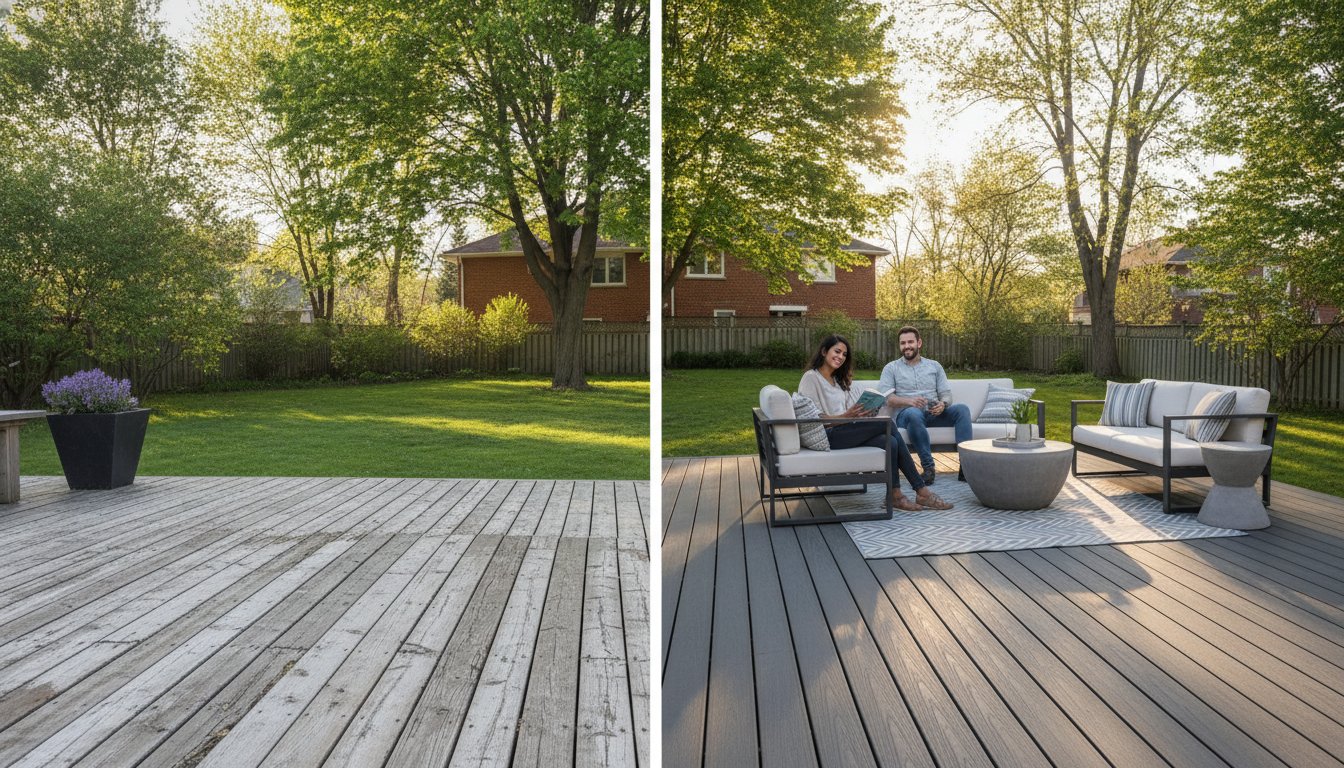
Deck resurfacing is a precision restoration process where we remove and replace the surface boards and railings while keeping the existing structural frame intact. This approach is often the most efficient way to handle deck repair and resurfacing Ottawa homeowners choose when their substructure remains sound. It allows you to upgrade the look and safety of your outdoor space without the cost of a full rebuild. However, the success of this method depends entirely on the condition of the skeleton beneath the surface, which faces constant environmental stress in the Ottawa Valley.
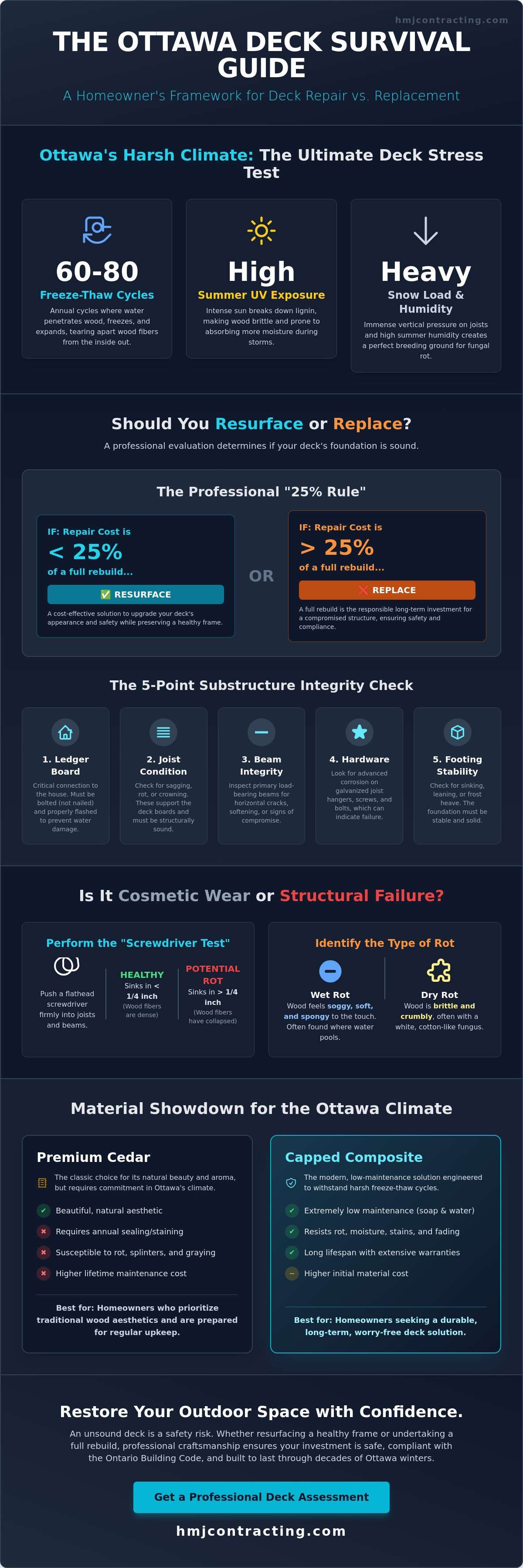
Our local climate is particularly aggressive due to the freeze-thaw cycle. Ottawa typically experiences between 60 and 80 of these cycles annually. When water penetrates wood pores and then freezes, it expands with enough force to physically tear wood fibers apart. This creates small fissures that grow larger every season. While winter ice does the heavy lifting, UV exposure in July is just as damaging. Intense summer sun breaks down the lignin in the wood, making it brittle and more susceptible to moisture absorption when the next storm hits. Additionally, heavy snow loads in Eastern Ontario put immense vertical pressure on structural joists and ledger boards, which are the critical points where your deck attaches to your home.
The Role of Moisture and Rot in Eastern Ontario
High humidity levels in Ottawa during the summer months create a perfect breeding ground for fungal growth within wood pores. Because much of our region sits on clay-heavy soil, moisture often stays trapped around deck posts. This leads to "ground-up" rot, where the base of the post softens while the top looks perfectly fine. It's vital to distinguish between "wet rot," which feels soggy and soft to the touch, and "dry rot," which leaves wood brittle, crumbly, and often covered in a white, cotton-like fungus. Both conditions compromise the various deck construction materials used in older local builds.
Structural Integrity vs. Cosmetic Wear
It is important to differentiate between surface graying and genuine structural failure. Graying is a cosmetic reaction to UV light that doesn't necessarily mean the wood is weak. Conversely, a "wobbly" deck in Nepean or Kanata often signals deep-seated footing issues or failing fasteners that require immediate attention. Structural integrity is the capacity of a deck to safely support and transfer specified live and dead loads to the ground as mandated by the Ontario Building Code. If your deck sways when you walk on it, the issue likely goes deeper than the surface boards.
Deck Repair vs. Full Replacement: A Decision Framework
Deciding whether to salvage your current structure or start from scratch is a technical evaluation. While deck repair and resurfacing Ottawa projects are popular for their efficiency, they are only viable if the substructure is fundamentally sound. We use the "25% Rule" to guide this choice. If the cost of necessary structural repairs exceeds 25% of the cost of a total replacement, a full rebuild is usually the more responsible long-term investment. In 2026, the rising cost of specialized labor often makes it more practical to replace a failing frame rather than attempting complex reinforcements on aged timber.
The ledger board is the most critical safety point in any deck. It's the point where the structure meets your house. If this connection is loose or lacks proper flashing, moisture will rot your home's rim joist, creating a massive safety hazard. A professional inspection focuses on these five key areas:
- Ledger Board: Ensuring it is bolted with structural screws and properly flashed to shed water.
- Joist Condition: Checking for "crown" or sagging that indicates the wood is reaching the end of its lifespan.
- Beam Integrity: Identifying any horizontal cracks or softening in the primary load-bearing beams.
- Hardware: Inspecting galvanized hangers and fasteners for signs of advanced corrosion.
- Footing Stability: Verifying that the deck isn't leaning or sinking due to poor ground contact.
Signs Your Deck Frame is Still Healthy
You can perform a simple "Screwdriver Test" to check the density of Canadian wood species like cedar or pressure-treated pine. Push a flathead screwdriver into the wood at the joists and beams. If it sinks in more than a quarter inch without resistance, the wood fibers have collapsed. You should also check for "frost heave." This is a common Ottawa issue where the ground freezes and pushes footings upward. If your deck remains level and the hardware is free of deep rust, resurfacing is likely a safe and effective option. For more advice on keeping your structure sound, read our Ottawa deck maintenance tips.
When a Full Rebuild is the Only Safe Option
Widespread "pith" rot is a dealbreaker. This occurs when decay reaches the center of the timber, compromising the entire structural skeleton. Modern 2026 safety standards also require footings to reach a depth of 1.2 meters to stay below the frost line. If your current deck sits on shallow "deck blocks" or old footings that have shifted significantly, resurfacing would be a waste of resources. In these cases, it is safer to work with Expert Deck Builders in Ottawa to design a new, compliant foundation that will last for decades.
The Professional Resurfacing Process: Step-by-Step Restoration
The process of deck repair and resurfacing Ottawa homeowners trust follows a methodical four-phase strategy. It starts with the safe removal of existing boards. Many older decks in the region, particularly those built before 2004, were treated with Chromated Copper Arsenate (CCA). These chemicals require careful handling and disposal according to Ontario environmental standards to prevent soil contamination. Professional deconstruction ensures the structural skeleton is preserved without damaging the home’s exterior envelope.
Once the frame is exposed, the second phase involves structural reinforcement. We identify any joists that show minor wear and strengthen them by adding "sister joists" alongside the originals. This effectively doubles the load-bearing capacity at critical points. Phase three focuses on leveling. Over time, even the best-built frames can settle. We use precision shimming and trimming to create a perfectly flat surface. This is essential for the seamless installation of new decking and updated railing systems in phase four.
Safe Demolition and Disposal in Ottawa
HMJ’s specialized demolition services provide a controlled environment for this initial stage. In Ontario, older pressure-treated lumber is classified as specific waste that shouldn't simply be tossed into a standard landfill. Our team manages the logistics of safe transport and disposal, ensuring your property remains clean and compliant with local waste management bylaws. This proactive approach prevents harmful chemicals from leaching into your garden or lawn during the teardown.
Joist Flashing and Longevity Upgrades
To extend the life of your original frame, we apply protective measures like butyl "Joist Tape." This creates a waterproof seal over the top of the joists, preventing moisture from sitting in screw holes and causing top-down rot. We also re-seal any cut ends of new lumber immediately with a field-cut preservative. Finally, we recommend upgrading all structural hardware to stainless steel. This prevents the unsightly rust streaks often seen on older Kanata or Orleans decks and ensures the connectors won't fail due to oxidation.
Choosing the Right Materials for Ottawa Decks in 2026
Selecting the right materials for deck repair and resurfacing Ottawa homeowners prioritize in 2026 requires a balance between aesthetic vision and technical durability. Our local climate presents extreme challenges, ranging from deep-freeze winters to humid, high-UV summers. Premium Western Red Cedar and modern capped composite are the primary contenders, each offering a different relationship with the elements of the Ottawa Valley.
Modern composite materials, particularly four-sided capped options, are engineered to prevent moisture penetration. This is a significant advantage in our region, where the high number of freeze-thaw cycles can quickly degrade porous materials. One technical factor to weigh is "Heat Retention." During Ottawa’s humid July heatwaves, darker composite boards can absorb substantial thermal energy. However, 2026 material advancements have introduced lighter pigments and heat-dissipating cores that remain comfortable for bare feet even in direct sunlight.
When analyzing maintenance over a 10-year period, the profiles diverge sharply. Natural wood requires a consistent cycle of cleaning, sanding, and re-staining every two to three years to maintain its structural integrity and color. Conversely, composite decking only requires a seasonal wash to remove surface debris. Many local property owners also consider the sustainability of local wood species like Eastern White Cedar, which offers a lower carbon footprint than synthetic alternatives that require industrial manufacturing processes.
Is Composite Worth the Investment?
The higher initial investment for composite decking is often offset by the long-term savings in labor and supplies. You won't need to purchase expensive sealers or spend weekends power-washing graying boards. Additionally, 2026 composite collections feature enhanced slip resistance. This is a critical safety upgrade for the slippery spring thaw and late-autumn rains common in Ottawa. For a more detailed breakdown of these options, see our guide on Composite vs. Wood Decks for Ottawa’s Climate.
The Timeless Appeal of Western Red Cedar
Cedar remains a favorite for its organic warmth and natural resistance to decay. It's an excellent choice for homeowners who prefer a traditional look that blends into the local landscape. However, Ottawa’s direct solar exposure can be unforgiving. You must apply high-quality, UV-rated stains to prevent the wood from becoming brittle and silvering prematurely. It's also vital to let new cedar "season" for several weeks to allow the moisture content to stabilize before your first application of sealer. This ensures the protective coating bonds correctly with the wood fibers.
If you're planning a project and need professional guidance on material selection, schedule a deck repair and resurfacing Ottawa consultation with our team to ensure your investment lasts for decades.
Why Professional Craftsmanship is Essential for Your Ottawa Deck
A deck is a high-stakes structure that must safely support significant weight while remaining exposed to the elements year-round. Professional deck repair and resurfacing Ottawa services require more than just basic carpentry skills. It demands a deep understanding of load-bearing physics and the specific requirements of the Ontario Building Code. We leverage over 25 years of experience to identify hidden structural flaws, such as compromised ledger connections or failing fasteners, that an untrained eye might miss during a casual walk-through.
Amateur installations often lead to "board cupping," where boards curl at the edges because they weren't fastened with the correct tension or spacing for moisture movement. Similarly, "popped screws" are a common safety hazard in the Ottawa Valley, often caused by the intense expansion and contraction cycles of our seasons. Our team ensures every fastener is seated correctly and every board is spaced to allow for optimal drainage. We also manage the complexities of BCIN requirements and local zoning bylaws. For example, any deck with a walking surface more than 24 inches above grade requires a formal building permit, and we handle these logistical hurdles to ensure your project is fully compliant.
The HMJ Advantage: Stability and Integrity
We take a neighborly approach to project management that prioritizes clarity and honesty. You can expect a transparent breakdown of costs with no hidden fees or mid-project surprises. Our multi-disciplinary background in renovations and asbestos removal demonstrates the level of technical rigor and safety consciousness we bring to every job site. We understand that your home is your sanctuary. We maintain a clean, organized workspace to ensure the safety of your family and pets throughout the entire restoration process.
Ready to Restore Your Outdoor Living Space?
Resurfacing your deck is a strategic investment that delivers beauty, safety, and longevity for a fraction of the cost of a total rebuild. By focusing on the structural health of your frame and utilizing high-performance materials, you can create a space that stands up to the next two decades of Ottawa weather. Don't leave your property value or your family's safety to chance. The first step toward a revitalized backyard is a professional assessment of your current structure. Contact us today to schedule your Ottawa deck consultation and let's ensure your outdoor space is ready for the seasons ahead.
Secure the Future of Your Outdoor Living Space
Restoring your deck is a technical investment in your home’s safety and longevity. By evaluating your structure's integrity and choosing materials that thrive in the Ottawa Valley, you can extend the life of your outdoor space by decades. A successful project balances high-quality components with the precision of experienced craftsmanship to ensure every board and fastener withstands our extreme seasonal shifts.
Choosing a partner for deck repair and resurfacing Ottawa means finding a team that values transparency as much as technical skill. HMJ Contracting provides over 25 years of local industry experience, offering the stability and reliability you need for a major renovation. Our certified installers and structural specialists work with transparent, fixed-price renovation contracts, so you won't have to worry about hidden fees or shifting timelines. It's time to transform your weathered deck into a safe, durable retreat for your family.
Request Your Professional Deck Inspection from HMJ Contracting and take the first step toward a beautiful, worry-free backyard today.
Frequently Asked Questions
Can I resurface my deck myself, or do I need a professional?
While a DIY approach is possible for simple board replacement, professional deck repair and resurfacing Ottawa ensures the underlying structure is fundamentally safe. We often find hidden rot or loose ledger boards that homeowners might overlook during a casual inspection. A professional has the specialized tools to level the frame and reinforce joists, ensuring your renovation meets the Ontario Building Code requirements for load-bearing safety.
How long does a typical deck resurfacing project take in Ottawa?
A typical resurfacing project generally takes between three to five business days to complete once the site is prepared. This timeline includes the safe demolition of old boards, a thorough structural inspection, joist reinforcement, and the final installation of new decking and railings. Larger or multi-level decks may take slightly longer, and our team always accounts for local weather patterns to ensure a high-quality finish.
Will resurfacing my deck increase my home’s resale value?
Resurfacing your deck is an effective way to boost your property value without the significant expense of a full rebuild. A restored outdoor space improves curb appeal and provides a move-in ready feel for potential buyers. In the competitive Ottawa real estate market, a safe and attractive deck is a significant selling point that demonstrates the home has been well-maintained.
Is a permit required for deck resurfacing in the City of Ottawa?
In the City of Ottawa, a building permit is generally not required if you are only replacing deck boards and railings on an existing, compliant structure. However, you must obtain a permit if you are making structural changes, increasing the deck's footprint, or if the walking surface is more than 600 mm above grade. We can help you navigate these municipal requirements to ensure your project remains compliant.
What is the best time of year to repair or resurface a deck in Ontario?
The ideal window for deck restoration in Ontario runs from late May through early October. You want consistent temperatures and periods of lower humidity to ensure that wood sealers or composite materials bond correctly. While we can perform structural repairs during colder months, the final surfacing and any necessary staining are best handled when the frost is gone and the wood is dry.
How do I know if my deck joists are rotten without removing the boards?
You can often identify rot by inspecting the joists from underneath the deck using a flashlight and a flathead screwdriver. Look for dark, soft spots or areas where the wood appears to be crumbling or flaking. If the screwdriver sinks easily into the timber, the joists are compromised. Persistent bouncing or swaying when you walk on the deck surface is another sign of weakened structural integrity.
Does HMJ Contracting offer warranties on deck resurfacing work?
HMJ Contracting takes full accountability for the quality of our craftsmanship and the integrity of the materials we install. We follow all manufacturer-specific installation guidelines to ensure that your material warranties remain valid and enforceable. Our commitment to stability means we don't consider a project finished until the client is completely satisfied with the safety and aesthetics of their restored deck.
What is the price difference between wood and composite resurfacing in 2026?
Composite materials have a higher upfront cost than pressure-treated wood or cedar but offer significant long-term savings. In 2026, many homeowners choose composite because it eliminates the need for expensive annual staining and sanding. While wood is more affordable initially, the cumulative cost of maintenance and supplies over a ten-year period often makes composite the more economical choice for Ottawa properties.