
Most homeowners believe a contractor's license is a single piece of paper they can simply ask to see before a renovation starts. In reality, that specific document doesn't exist in our province. Learning how to check a contractor's license in Ontario requires a more thorough, three-tier approach that covers municipal permits, provincial trade certifications, and business safety standing. You want to protect your investment and avoid the nightmare of a renovation scam; it's a priority we take seriously at HMJ Contracting.
It's natural to feel confused when trying to distinguish between a city business license and a provincial trade qualification. This guide provides the exact steps to verify an Ontario contractor's credentials to ensure your project remains legal, safe, and fully insured. We will walk you through a clear checklist for verification, explain the difference between WSIB and liability insurance, and show you how to access official databases like the Skilled Trades Ontario register. By the end, you'll have the technical clarity needed to move forward with quiet confidence and the peace of mind that your home is in capable hands.
Key Takeaways
- Learn why "licensed" in Ontario is a combination of municipal business permits and provincial trade certifications rather than a single document.
- Discover the exact steps for how to check a contractor's license in Ontario using official portals like the Skilled Trades Ontario public register.
- Understand why verifying a $2,000,000 liability insurance policy and a valid WSIB clearance certificate is essential to protecting your property from financial risk.
- Identify common red flags, such as contractors who pressure you to skip building permits or offer steep discounts for cash-only payments.
- Gain the confidence to hire a professional partner by knowing which documents to request upfront before any demolition or renovation work begins.
The Layers of Contractor Licensing in Ontario
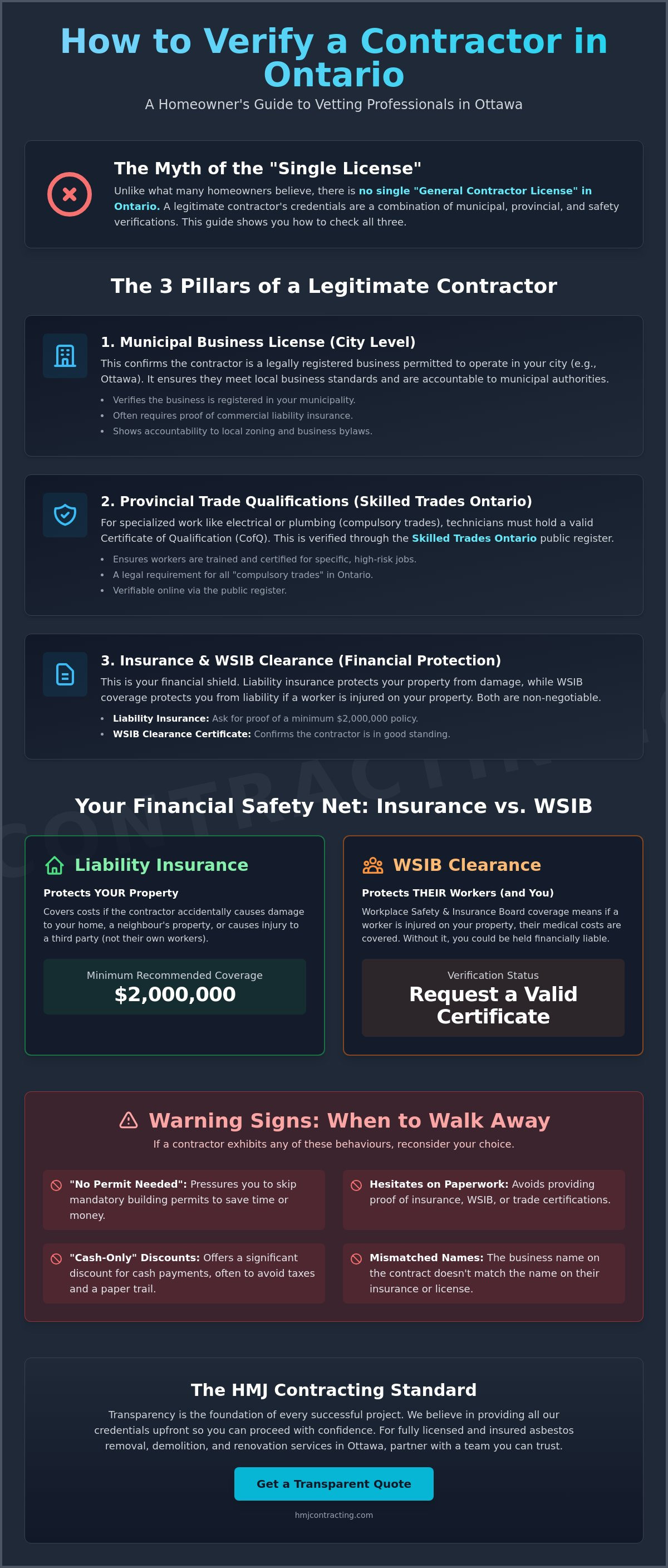
The term "licensed" is often used loosely in the construction industry, but for an Ontario homeowner, it has a specific, multi-layered meaning. There is no single provincial "General Contractor" license that covers every type of work. Instead, a legitimate professional must navigate a system of municipal business permits and provincial trade qualifications. If you are looking into how to check a contractor's license in Ontario, you first need to identify which layer of authority governs the specific work being done on your property. It's about safety, accountability, and ensuring the person handling your demolition or renovation is legally permitted to do so.
For 2026, the Home Construction Regulatory Authority (HCRA) remains the primary body for licensing new home builders and sellers. However, most renovation and asbestos removal specialists do not fall under the HCRA's jurisdiction unless they are constructing a brand new residential dwelling. For projects like deck construction or mold remediation, authority shifts to municipal offices and trade-specific regulators. Understanding this distinction is the first step in protecting your investment. Our guide on how to check a contractor's license in Ontario starts with recognizing that different tasks require different credentials.
Municipal vs. Provincial Authority
Cities like Ottawa manage their own licensing programs to ensure local businesses meet safety and zoning standards. A municipal license proves the business is registered to operate within city limits and often requires proof of insurance. However, provincial trade licenses take precedence for specialized work. While a contractor might have an Ottawa business license for general improvements, they still require specific certifications for compulsory trades. This regulatory framework evolved from the previous oversight of the Ontario College of Trades, moving toward the current Skilled Trades Ontario system. You must verify that the scope of work matches the specific credentials held by the team on your site. Don't assume a city permit covers technical trade skills.
Why Verifying a License is Non-Negotiable in 2026
Skipping the verification process carries significant financial and legal risks. Hiring unlicensed workers for structural changes or hazardous tasks can lead to immediate work-stoppage orders from city inspectors. Even more concerning is the impact on your home insurance. Most providers will deny claims for damages caused by uncertified individuals; this leaves you personally liable for the costs. The Consumer Protection Act ensures that contractors provide clear information about their business and gives homeowners the right to a written contract that includes specific licensing details. At HMJ Contracting, we believe transparency is the foundation of every successful project. We provide our credentials upfront so you can proceed with quiet confidence.
3 Steps to Verify an Ontario Contractor’s License
Once you understand that licensing is layered, you need a systematic way to vet your potential partner. Knowing how to check a contractor's license in Ontario involves more than a quick Google search; it requires verifying records across multiple databases. Start by cross-referencing the business name on the contract with their registered legal entity. Many companies operate under a marketing name, but their licenses and insurance will be held under their official corporate title. If the names don't match, ask for clarification before signing any agreements.
Following a standard verification process ensures your project meets the high standards required for safety and longevity. First, check the municipal directory for a valid business license. Second, confirm that any technicians performing compulsory trades in Ontario are properly certified. Third, consult the HCRA Ontario Builder Directory if your project involves a large-scale addition or a new residential build. This methodical approach to how to check a contractor's license in Ontario is the best way to avoid the common pitfalls of the unverified market.
Checking Local Ottawa Licensing
The City of Ottawa maintains a database for various service providers, including those specializing in renovations and demolition. When you search the directory, look for an active status and check for specific designations. A "Master" designation often indicates a higher level of experience and testing than a "Journeyman" level. If your contractor is based in Kanata or Nepean but working in central Ottawa, they must still comply with these municipal standards. Reviewing a renovation planning guide can help you organize these documents early in the process.
Verifying Trade-Specific Credentials
Specialized work requires additional oversight to ensure technical excellence. For any electrical components of your renovation, use the Electrical Safety Authority (ESA) search tool to confirm the contractor holds a valid ECRA/ESA license. Similarly, plumbing and HVAC technicians must be in good standing with provincial regulators. If your project is a design-build that involves structural changes, ask for a Building Code Identification Number (BCIN). This number confirms the person designing your changes is qualified under the Ontario Building Code. Choosing a team that provides all documentation upfront simplifies this verification step for you.
Beyond the License: Insurance and WSIB Clearance
A municipal business permit is a vital first step, but it's only half the battle. A license alone doesn't protect you if a worker is injured on your property or if a structural error causes significant damage. This is where active liability insurance and WSIB clearance become essential. When you look into how to check a contractor's license in Ontario, you must treat these financial safeguards as mandatory requirements rather than optional extras. They are the safety net that ensures your renovation doesn't turn into a legal or financial burden.
The Workplace Safety and Insurance Board (WSIB) plays a critical role in the Ontario construction industry. Most contractors are legally required to register and remain in good standing. If you hire a team without a valid clearance certificate, you could be held liable for unpaid premiums or injury claims that occur on your site. For 2026, the WSIB average premium rate is $1.23 per $100 of insurable payroll, and reputable companies factor this into their professional operations. You can request a WSIB Clearance Certificate for free; it's a real-time document that proves the contractor's account is active and paid up to date.
Verifying Liability and Property Insurance
For any significant renovation or demolition project in Ottawa, you should expect a minimum of $2,000,000 in Commercial General Liability (CGL) insurance. This amount is the standard for 2026 and is often a prerequisite for obtaining municipal building permits. When a contractor provides a Certificate of Insurance (COI), verify that the policy is current and that the legal name matches the business on your contract. If your project involves specialized electrical work, you can also use ESA's contractor look-up tool to verify their trade standing. For a deeper dive into vetting local professionals, read our guide on Hiring a General Contractor in Ottawa.
Asbestos and Hazardous Material Certification
Standard general contracting licenses don't automatically grant a company the right to handle hazardous materials. If your project involves mold remediation or asbestos removal, the contractor needs specific training certificates for Type 1, 2, or 3 remediation. These certifications ensure the team follows strict provincial safety protocols to prevent cross-contamination in your home. At HMJ Contracting, we maintain these high standards to protect our clients and our crew. You can find more information on these safety benchmarks in our resource on Asbestos Removal in Ottawa. Verifying these specific credentials is a core part of learning how to check a contractor's license in Ontario for older homes.
Red Flags: When to Walk Away from a Contractor
Trust your instincts during the initial consultation. If a service provider seems evasive when you ask how to check a contractor's license in Ontario, it's usually a sign of deeper compliance issues. A professional partner should offer their credentials with quiet confidence. They understand that your home is a significant investment and that technical clarity builds the foundation of a successful relationship. When a contractor lacks a physical business address or provides a contract that misses a specific license number, you are likely dealing with a high-risk entity. Professionalism isn't just about the tools; it's about the accountability that comes with a registered business.
- Refusal to provide WSIB or Insurance: A reputable company will provide a current WSIB clearance certificate and proof of liability insurance immediately upon request. If they claim these documents aren't necessary for "small jobs," walk away.
- The "Cash Only" discount: This trap voids your legal standing and removes any paper trail for the work performed. Without an invoice, you have no recourse under the Ontario Consumer Protection Act if the renovation fails.
- Vague scope of work: Contracts should be detailed, outlining the specific demolition or renovation steps to be taken. Avoid any agreement that uses generalities instead of technical milestones.
The Danger of Skipping Permits
Pressure to skip the building permit process is a massive red flag. Some contractors claim permits are just a tax or will slow down the project, but this unverified work often results in municipal fines or structural failures that appear years later. A licensed professional always insists on following the Ontario Building Code to ensure the safety of your family and the longevity of the structure. It's a major red flag if a contractor asks you to pull the permit yourself; this is often a tactic to shift all legal liability away from the business and onto the homeowner.
The "Door-to-Door" Renovation Scam
High-pressure tactics are common in seasonal Ottawa scams, particularly with roofing or driveway work. These individuals often claim to have leftover materials from a nearby job in Kanata or Orleans and offer a "today only" price. Under the Ontario Consumer Protection Act, you have a 10-day "cooling off" period for contracts signed in your home, but these scammers often disappear before you can exercise your rights. Always verify a contractor's physical office location and local reputation before agreeing to any services. For a team that prioritizes transparency and professional standards, contact HMJ Contracting for a detailed project review.
The HMJ Contracting Standard: Transparency and Compliance
HMJ Contracting INC has spent over 25 years establishing a reputation for technical excellence across the Ottawa and Kanata communities. While we've detailed the technical steps for how to check a contractor's license in Ontario, our goal is to make that verification process effortless for our clients. We believe that professional accountability should be proactive. That's why we provide our municipal licenses, current WSIB clearance certificates, and proof of $2,000,000 liability insurance before you even have to ask. This level of transparency ensures your renovation or demolition project begins on a foundation of absolute trust and legal security.
Our specialized certifications in asbestos removal and mold remediation further distinguish our team from general renovators. These aren't just standard business permits; they're technical qualifications that ensure hazardous materials are handled with surgical precision and in full compliance with provincial safety laws. We take a proactive role in project success by managing the entire permit and inspection process. You won't have to navigate the complexities of the Ontario Building Code or deal with city hall paperwork on your own. We handle the logistical details so you can focus on the creative vision for your home or business.
A Local Partner You Can Trust
We've served the local residential and commercial market with a commitment to stability and high standards that only comes with decades of experience. Whether we're designing custom decks or managing complex structural renovations, safety remains our primary focus. We treat every project as a long-term investment in our community's reputation. Our team handles complex challenges with composure, ensuring that every phase of your project is methodical and well-managed. For more practical advice on property improvements and local regulations, visit the HMJ Contracting Blog for expert insights tailored to the Ottawa region.
Get Started with a Verified Professional
Your 2026 project deserves the attention of a seasoned professional who understands the importance of technical clarity and neighborly approachability. During our initial consultation, we'll walk you through our credentials and explain how our methodology aligns with provincial standards. We provide a detailed, transparent quote that reflects our commitment to integrity; we don't believe in vague estimates or hidden fees. You'll receive a clear roadmap for your project, from the initial demolition to the final completion. Contact HMJ Contracting today for a safe, licensed renovation and experience the peace of mind that comes with hiring a verified local expert who prioritizes your investment.
Secure Your Investment with Professional Verification
Verifying a professional's credentials is the most effective way to safeguard your property and your peace of mind. You now understand that a "license" is actually a multi-layered verification process involving municipal business registration and provincial trade certifications. Learning how to check a contractor's license in Ontario gives you the technical clarity required to separate seasoned experts from high-risk operators. Always remember that active WSIB clearance and substantial liability insurance are the pillars of a safe renovation; they protect you from unforeseen financial burdens.
At HMJ Contracting, we believe in leading with transparency. With over 25 years of experience serving the Ottawa area, we've built our reputation on integrity and technical skill. Our team consists of certified asbestos and mold remediation experts who maintain full WSIB and liability coverage for every project. We handle the complexities of the permit process so you can focus on the final result. Your home deserves a partner committed to the highest standards of craftsmanship and compliance. Book a Consultation with a Fully Licensed Ottawa Contractor today and move forward with quiet confidence.
Frequently Asked Questions
Do all contractors in Ontario need to be licensed?
Not every contractor holds a single provincial license because Ontario regulates by specific trade and municipality. While general renovators require a city-issued business license to operate in Ottawa, they don't have a standalone provincial "General Contractor" certificate. It's essential to understand that "licensed" usually refers to a combination of municipal permits and technical trade qualifications for specific tasks like electrical work or plumbing.
How do I check if a contractor has a valid Ottawa business license?
You can verify a local professional through the City of Ottawa’s online business directory. This portal allows you to search by the company’s legal name to ensure their operating permit is active and in good standing. If you're learning how to check a contractor's license in Ontario for an Ottawa-based project, this municipal check is your first line of defense against unverified businesses.
What is the difference between a contractor license and a trade certificate?
A contractor license is a municipal permit that grants a business the legal right to offer services within a city. In contrast, a trade certificate is a provincial credential issued to individuals who have completed specific training in a compulsory trade. For example, a renovation company needs an Ottawa business license, but the person doing your wiring must hold a valid electrical certificate from the province.
How can I verify if my contractor is covered by WSIB in 2026?
Verification is simple through the WSIB’s online e-Clearance system. You should request a real-time clearance certificate from your contractor before any work begins on your property. This document confirms the business is registered and that their account is active. For 2026, the average premium rate is $1.23 per $100 of payroll; seeing a valid certificate ensures you aren't liable for any workplace injuries or unpaid premiums.
Does a renovation contractor need to be registered with the HCRA?
Most renovation contractors do not need to register with the Home Construction Regulatory Authority (HCRA). This provincial body specifically licenses builders and sellers of new homes. If your project is a standard kitchen remodel, basement renovation, or deck build, the contractor's municipal license and trade certifications are the relevant credentials to verify. HCRA oversight only applies if the project involves building a brand-new residential dwelling.
What should I do if a contractor refuses to show their license or insurance?
You should stop the process immediately and find a different service provider. Refusal to provide documentation is a significant red flag that suggests the business is operating without legal authority or financial protection. Legitimate professionals, like the team at HMJ Contracting, provide these documents upfront. Hiring an unverified worker leaves you personally liable for damages and injuries, which can lead to devastating financial consequences.
Is a contractor’s license the same as a BCIN?
No, these are entirely different credentials used for different purposes. A contractor's license is a business permit, while a Building Code Identification Number (BCIN) is required for individuals who provide design services or submit permit drawings. If your renovation involves structural changes, the person designing the plans must have a BCIN to prove they understand the Ontario Building Code requirements for safety and structural integrity.
How do I check for past complaints or legal issues against an Ontario contractor?
You can consult the Ministry of Public and Business Service Delivery’s Consumer Beware List to see if the business has a history of provincial charges or convictions. Researching how to check a contractor's license in Ontario should also include reviewing the Better Business Bureau and local court records for civil litigation. These resources provide a clearer picture of a company's reputation and past performance within the Ottawa community.