
Before you sign anything or hand over a deposit, run five official checks: confirm the contractor's registration in the HCRA directory, verify any electrical work through the ESA contractor locator, pull a current WSIB clearance, confirm municipal permits with City of Ottawa Building Code Services, and demand a written contract with a 10% holdback clause. These are not optional courtesies — they are the legal and financial safeguards that protect you if something goes wrong.
Quick vetting checklist:
- HCRA registration confirmed (builder/renovator licence)
- ESA 7-digit ECRA/ESA licence number verified (electrical work)
- WSIB clearance certificate number checked and current
- Municipal permit pulled by the contractor, not you
- Written contract with scope, timeline, payment schedule, and 10% holdback
- Proof of liability insurance (minimum $2M recommended)
- Asbestos/abatement report on file if demolition or disturbance is involved
Table of Contents
- How to verify licences, insurance, and permits step by step
- What to ask contractors and which answers should stop you
- What abatement work requires beyond standard licensing
- Which trades need separate licences and how you verify them
- What to expect for timelines, deposits, and costs in Ottawa
- Contract clauses you must have before work starts
- Key takeaways
- Why the official checks matter more than you think
- HMJ Contracting: licensed abatement and renovation in Ottawa
- Useful official sources
How to verify licences, insurance, and permits step by step
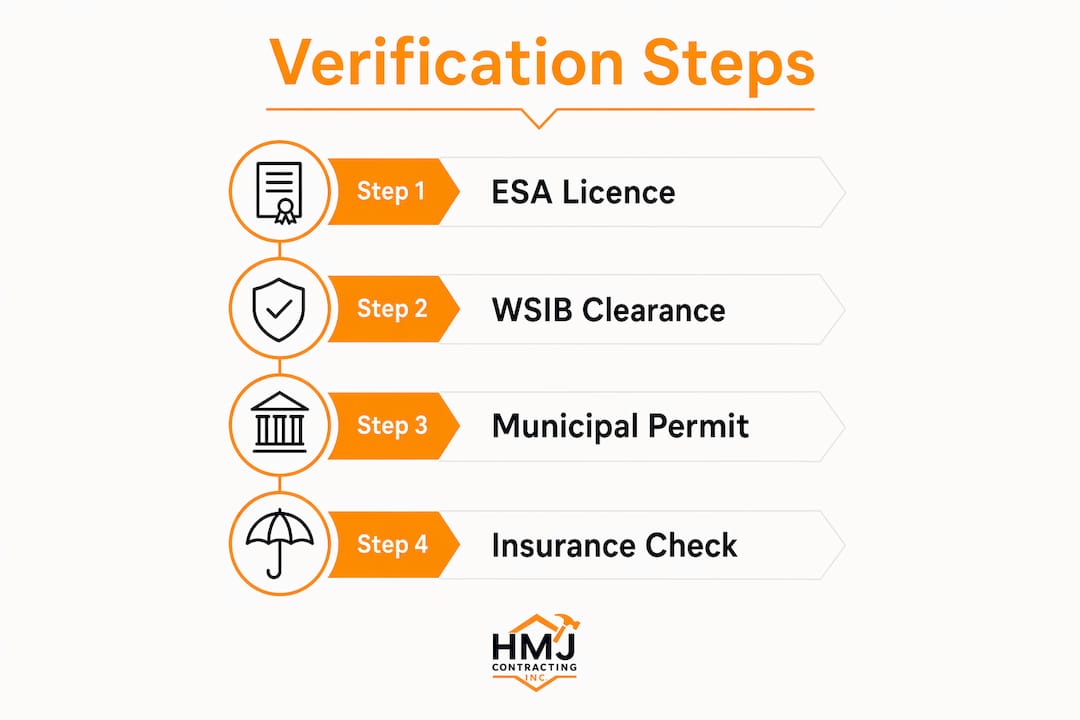
Verification takes less than 30 minutes and can save you from a costly dispute. Work through these steps before any interview or payment.
Step 1 — Get the legal business name and licence numbers. Ask for the contractor's registered business name, not just a trade name. Search the HCRA online directory to confirm builder or renovator registration in Ontario.
Step 2 — Verify electrical credentials through ESA. For any electrical scope, ask for the 7-digit ECRA/ESA licence number and look it up on the ESA contractor locator. Only Licensed Electrical Contractors can be hired for electrical work, and they must file ESA notifications themselves. If the contractor suggests you file the notification, that is a red flag.
Step 3 — Confirm WSIB clearance. Request the WSIB clearance certificate number and verify it directly at the WSIB portal. Check the expiry date. A clearance that lapsed last month offers you no protection today.

Step 4 — Check municipal permits. Contact City of Ottawa Building Code Services to confirm that required permits were pulled under the contractor's name, not yours. Ask for the permit number and the inspection schedule.
Step 5 — Verify liability insurance. Ask for the certificate of insurance and call the insurer directly to confirm the policy is active and covers your project. The Ottawa Construction Network recommends a minimum of $2M in general liability coverage.
What to ask contractors and which answers should stop you
A legitimate contractor welcomes these questions. Hesitation or deflection is itself an answer.
Questions to ask on the phone or at the site:
- "What is your HCRA registration number?"
- "Can you give me your ECRA/ESA licence number now so I can verify it?"
- "What is your WSIB clearance certificate number and when does it expire?"
- "Who will pull the permits for this project?"
- "Can I see your proof of liability insurance and the insurer's name?"
- "Which subcontractors will be on site, and are they licensed and insured?"
- "What is your procedure if you find asbestos or other hazardous material during demolition?"
Red-flag answers to watch for:
- Asks you to pull the permits or file ESA notifications
- Refuses to provide licence numbers or says "you can trust me"
- Pressures you to sign the same day or offers a discount that expires tonight
- Proposes a verbal agreement or a vague one-page contract
- Claims to be available to start immediately on a large project
- Cannot name the subcontractors or confirm their credentials
Pro Tip: Ask for the WSIB clearance number and the insurer's name in the same breath. A contractor who answers both without hesitation has done this before. One who stalls on either has not.
ESA guidance is clear: a legitimate contractor will be proud to show credentials and will not be defensive when you ask to verify them. Contractors who pressure clients to sign immediately may be trying to avoid scrutiny or inspections.
What abatement work requires beyond standard licensing
Hazardous-material work carries legal obligations that go beyond a general contractor's licence. If your Ottawa property was built before the 1990s, assume asbestos-containing materials (ACM) may be present until a qualified assessment says otherwise.
Under Ontario Regulation 278/05, the owner must commission an asbestos assessment before any demolition, alteration, or repair work is tendered or arranged. That report must be provided to all prospective contractors so they can price regulatory obligations accurately.
Before any demolition or disturbance work begins, the owner is legally required to have an asbestos assessment completed and shared with all contractors bidding on the project. Skipping this step does not reduce your liability — it increases it.
Additional documents and checks for abatement projects:
- Proof of the abatement contractor's certified training and accreditation
- Disposal chain of custody: who transports the waste and to which licensed facility
- Air-monitoring plan: who conducts monitoring, at what intervals, and what triggers a work stoppage
- Written procedure for unexpected ACM discoveries, including notification duties to the Ministry of Labour under Ontario regulation
- Abatement pricing that explicitly includes testing, air monitoring, and waste disposal — not as add-ons
Which trades need separate licences and how you verify them
A general contractor cannot legally perform electrical or gas work. They must hire licensed sub-trades and be transparent about who those sub-trades are.
Electrical work: Only a Licensed Electrical Contractor (LEC) with a 7-digit ECRA/ESA licence can be engaged for electrical scope. The LEC files ESA notifications — not the homeowner, and not the general contractor on the LEC's behalf. Verify the number at the ESA contractor locator. Ontario law is explicit: operating without an ESA licence is not permitted.
Gas and HVAC work: Confirm TSSA certification for any gas-line or gas-appliance work. Ask for the certificate number and verify it at tssa.org. The contractor performing the work files the applicable permits.
Subcontractor verification: Request the licence number, WSIB clearance, and proof of insurance for every sub-trade who will be on your property. Include those details in the main contract. A general contractor who cannot or will not provide sub-trade credentials is not managing the project transparently.
For a broader look at which specialists are required for different scopes, the types of professional renovation contractors guide covers the distinctions clearly.
What to expect for timelines, deposits, and costs in Ottawa
Quality contractors in Ottawa are typically booked weeks to months ahead. If someone can start your kitchen renovation next Monday, ask why.
| Project size | Typical duration | Payment structure |
|---|---|---|
| Small (bathroom refresh, flooring) | 1–2 weeks | Small deposit; balance on completion |
| Medium (kitchen, basement) | 3 weeks | Staged payments tied to milestones |
| Large (addition, full reno) | 2 months | Staged payments; statutory 10% holdback |
Under Ontario's Construction Act, a 10% holdback on all payments is mandatory for 60 days after substantial completion. This protects you from subcontractor liens. A professional contractor will expect this clause and include it without argument.
Pro Tip: Never waive the 10% holdback, even if the contractor offers a discount in exchange. The holdback is your statutory protection under provincial law, not a negotiating chip.
Municipal permit fees in Ottawa vary by project scope and are set by the City's fee schedule. Expect a legitimate quote to include permit fees as a line item, not as a vague "miscellaneous" charge.
Contract clauses you must have before work starts
Ontario consumer protection guidance requires written contracts for home improvement work. A solid contract protects both parties and removes ambiguity before a dispute arises.
Required contract elements:
- Contractor's legal business name, address, and all applicable licence numbers (HCRA, ECRA/ESA, TSSA)
- WSIB clearance number and insurer name with policy limits
- Detailed scope of work, materials specified by brand and grade where relevant
- Timeline with start and completion dates and milestone definitions
- Payment schedule tied to milestones, not calendar dates
- Permit responsibilities: the contractor pulls all permits
- Change-order procedure: written approval required before any scope change
- 10% holdback language referencing the Construction Act
- Completion and inspection acceptance criteria
- Procedure for unexpected hazardous material discoveries, including who pays for additional testing
Pro Tip: Add a clause that requires the contractor to notify you in writing within 24 hours of any suspected ACM discovery and to halt disturbing work in that area until a qualified assessor confirms the material type. This one clause can prevent a regulatory violation that costs far more than the delay.
For a full breakdown of what a renovation contract should cover, the renovation permit application process guide walks through permit responsibilities in detail.
Key takeaways
Vetting a licensed renovation contractor in Ottawa comes down to five official checks, a written contract with a 10% holdback, and an asbestos report before any demolition begins.
| Point | Details |
|---|---|
| Run official checks first | Confirm HCRA, ESA (LEC), and WSIB clearance before any interview or payment. |
| Demand written documentation | A written contract, itemized quote, and proof of $2M liability insurance are non-negotiable. |
| Protect yourself with holdback | The Construction Act's 10% holdback applies for 60 days after substantial completion — never waive it. |
| Abatement needs extra steps | An Ontario-required asbestos assessment must be completed and shared with contractors before demolition work is tendered. |
| Hmjcontracting is a vetted local option | HMJ Contracting holds certified abatement credentials, carries WSIB and liability insurance, and handles permits for Ottawa homeowners. |
Why the official checks matter more than you think
Most homeowners I speak with assume that a contractor with a professional-looking website and good reviews is automatically legitimate. Reviews matter, but they cannot tell you whether the electrical work was filed with ESA, whether the WSIB clearance was current on the day of the job, or whether the abatement contractor held valid certification when they removed that popcorn ceiling.
The official registers exist precisely because word-of-mouth is not enough. A contractor can complete fifty jobs without incident and still be unlicensed — until the one job where something goes wrong and the homeowner discovers they have no recourse. In Ottawa, where a significant portion of the housing stock predates modern asbestos regulations, the abatement checks are not a formality. They are the difference between a safe renovation and a health and liability problem that follows the property for years.
Keep copies of every document: the WSIB clearance, the insurance certificate, the permit numbers, and the asbestos report. If a concern arises during the project, City of Ottawa Building Code Services and Ontario's provincial consumer protection office are the right places to escalate — not just the contractor's voicemail.
HMJ Contracting: licensed abatement and renovation in Ottawa
Ottawa homeowners who want a contractor that has already passed the checks described in this guide have a direct option. HMJ Contracting has over 25 years of experience in residential and commercial construction across Ottawa, with certified abatement services for asbestos, lead, and mould, and full-service renovation and demolition capabilities.

Every HMJ project starts with a transparent, itemized quote. The team carries WSIB coverage and liability insurance, pulls all required permits, and follows certified disposal and air-monitoring procedures for hazardous-material work. That combination of credentials and process is what a 5.0 Google rating reflects across hundreds of completed projects.
For abatement work, visit the certified abatement services page. For full renovation and demolition scopes, the services overview covers the full range. Mould remediation is available at the mould remediation page. Contact HMJ Contracting today for a free quote on your Ottawa project.
Useful official sources
Use these directly to verify credentials and confirm your legal rights before hiring:
- HCRA online directory — verify builder and renovator registration in Ontario
- ESA contractor locator — confirm a 7-digit ECRA/ESA licence for electrical contractors
- WSIB clearance portal — verify current workplace safety insurance and clearance expiry
- City of Ottawa Building Code Services — confirm permit status, permit numbers, and inspection records
- Ontario Regulation 278/05 — Asbestos — the governing regulation for asbestos on construction projects
- Ontario asbestos regulation guide — plain-language guide to owner and contractor obligations
- Ottawa Construction Network — practical contractor fraud prevention and contract guidance
- Ontario consumer protection (ontario.ca) — your rights when starting home renovations or repairs
To report an unlicensed electrical contractor, contact ESA directly. For permit violations or unsafe construction, contact City of Ottawa Building Code Services. For broader consumer complaints, Ontario's consumer protection office handles disputes involving written contract requirements and contractor conduct. Keep every document, photo, and written communication from the project.
This article is general information for Ottawa homeowners and is not legal or regulatory advice. Confirm current requirements with the relevant authority (HCRA, ESA, WSIB, City of Ottawa) or a qualified professional for your specific project.