
A renovation quote breakdown is a line-item document that lists every cost component of a project, from trade labour to permit fees, so you know exactly what you are paying for before work begins. Homeowners who understand what does a renovation quote breakdown include are far less likely to face surprise charges mid-project. A proper itemised quote separates labour, materials, subcontractor fees, contingency allowances, and exclusions into distinct sections. Without that structure, you are signing a blank cheque. This guide walks through every component you should expect to see, how each one works, and what to do when something is missing.
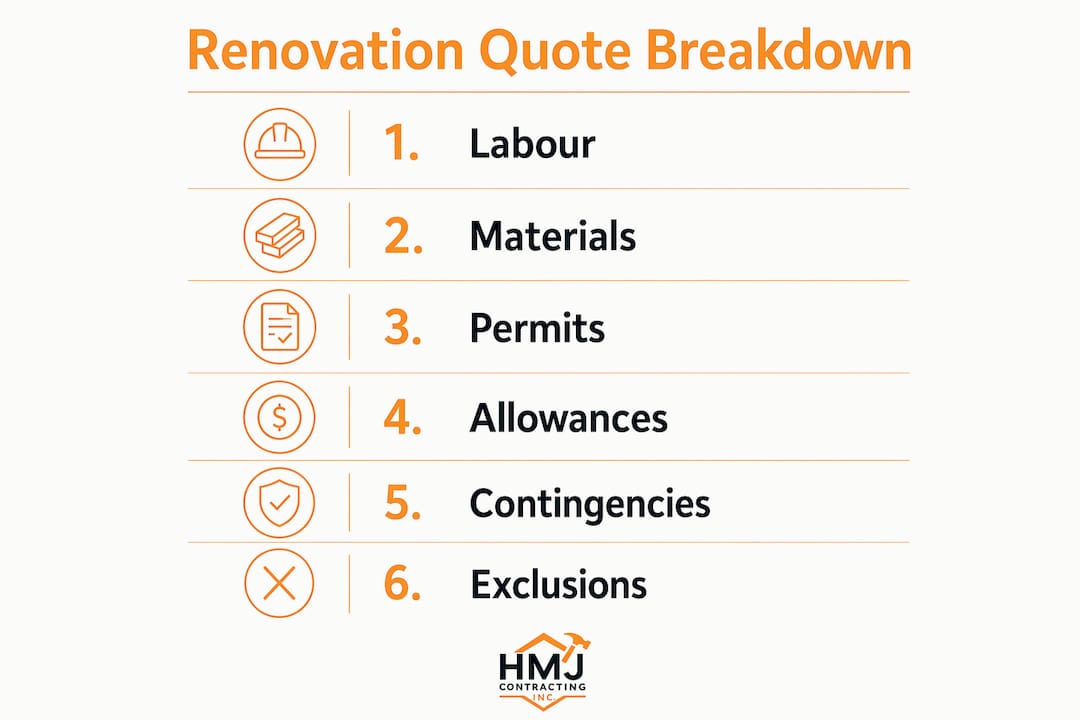
What does a renovation quote breakdown include?
A complete renovation quote must itemise costs by trade, not present a single lump sum. Line-item quotes by trade are the industry standard, with deposits set at 10–15% at signing and all subsequent payments tied to project milestones. That structure protects you from paying for work that has not yet happened.
The core sections of a detailed renovation estimate are:
- Labour costs broken down by trade, estimated hours, and hourly rate
- Material costs with exact product specifications including brand, model, and quantity
- Subcontractor fees and any management markup the general contractor applies
- Permit and inspection fees listed as separate line items
- Demolition and disposal costs for debris removal and site clearing
- Contingency allowance of 10–15% to cover unforeseen site conditions
- Overhead and profit markup typically 15–25% on materials in the Canadian market
Each of these sections serves a specific purpose. Labour tells you who is doing the work and at what rate. Materials tell you exactly what is being installed. Permits confirm the contractor is working legally. Contingency signals that the contractor has thought about risk.
Labour typically accounts for 35–50% of residential renovation costs, with trades charging $50–$140 per hour in Canadian markets. Materials usually represent 30–45% of the total, with contractor markups ranging from 10–20%. Knowing these proportions helps you spot a quote that is padded or one that is suspiciously thin.

Pro Tip: Ask the contractor to identify which trades are their own employees and which are subcontractors. Subcontractor markups are legitimate, but you deserve to know where they appear in the quote.
Why material specifications matter
Quotes must include explicit material specifications such as brand and model number for major items. A quote that says "tile" without specifying the product leaves the door open for a quality downgrade after you sign. If the quote lists "ceramic tile, 12x24, Brand X, Model Y, $4.50/sq ft, 200 sq ft," you have a clear record. If it says "tile allowance," you need to ask more questions before you agree to anything.
How do allowances, contingencies, and exclusions affect the quote?
Allowances, contingencies, and exclusions are the three sections most likely to cause budget surprises if they are vague or missing entirely.
Allowances are placeholders for finishes you have not yet selected, such as tile, fixtures, or cabinetry. Allowances are most vulnerable to price manipulation when their boundaries are not clearly defined. A tile allowance, for example, may cover supply only and exclude installation. If the quote does not spell that out, you could face a separate labour invoice later. Always confirm whether an allowance covers supply only, or supply and installation.
Contingencies protect both you and the contractor when hidden conditions appear. Reputable contractors include a contingency allowance of 10–15% to cover issues like outdated wiring, rot, or unexpected structural problems. A quote with no contingency line is not a bargain. It means those costs will arrive as change orders after the project has started.
Exclusions tell you what the contractor will not do. Missing an exclusions list is a red flag because contractors can add those costs later as unexpected extras. A clear exclusions section might state that asbestos abatement, exterior work, or appliance installation falls outside the scope. That clarity lets you budget for those items separately or negotiate their inclusion upfront.
- Confirm every allowance covers supply and installation, not just supply
- Verify the contingency percentage is stated explicitly in the quote
- Read the exclusions list as carefully as the cost totals
- Ask the contractor to explain any "assumptions" listed in the document
Pro Tip: Treat the exclusions list as a checklist of work you still need to budget for. If abatement or demolition is excluded, contact a licensed specialist like Hmjcontracting to get a separate quote for those items before you finalise your renovation budget.
What does a professional payment schedule look like?
Payment schedules tied to project milestones are the standard for reputable renovation contracts in Canada. Clear payment schedules and change order policies protect both the client and the contractor. A milestone-based schedule means you pay when defined stages of work are complete, not on arbitrary calendar dates.
A typical payment structure looks like this:
- Deposit at signing: 10–15% of the total contract value
- Mobilisation payment: Due when materials are ordered or delivered to site
- Mid-project payment: Tied to a defined completion milestone, such as rough-in inspections passing
- Substantial completion payment: Released when the project is functionally complete
- Holdback: A final amount, often 10%, released after a deficiency walkthrough
A quote is an offer, not a contract. A contract ties pricing to scope, payment terms, and change order procedures. Without a documented scope linked to the quote, cost inflation through change orders becomes common. Make sure the payment schedule in your quote is carried directly into the signed contract.
Change orders are formal written amendments to the original scope. Transparency requires a clear change order policy detailing how modifications are documented, priced, and approved before work proceeds. Any contractor who asks you to approve verbal changes is transferring financial risk to you.
Pro Tip: Never approve a change order verbally. Require a written document that states the new scope, the cost impact, and the revised timeline before any additional work begins.
How to evaluate and compare renovation quotes
Comparing renovation quotes on price alone is the most common mistake homeowners make. Cheaper quotes often omit site protection, debris disposal, and permits to appear lower priced, with those costs passed back to you later as unforeseen expenses. The only way to compare quotes fairly is to confirm they cover identical scopes of work.
Use this checklist when reviewing each quote:
- Scope alignment: Confirm every quote covers the same work, materials, and finishes
- Labour detail: Each trade should show estimated hours and an hourly rate
- Material specs: Brand, model, and quantity must be listed for major items
- Permit fees: These should appear as a separate line item, not buried in overhead
- Contingency: Look for an explicit 10–15% contingency allowance
- Exclusions: Every quote should have a clear list of what is not included
- Insurance and licensing: Verify the contractor carries liability insurance and Workers' Compensation coverage
Lowest bids often lack contingency, detailed specs, and proper insurance, which increases financial and legal risk for homeowners. Cash-only discounts offered to avoid taxes are illegal under Ontario's Construction Act. That is not a savings opportunity. It is a liability.
For roofing work specifically, a roofing estimate breakdown follows the same line-item logic: trade labour, materials by product, disposal, and permit fees all listed separately. The same standard applies across every trade in a full renovation.
Understanding how renovation scope of work is defined before you request quotes gives you a significant advantage. When you can describe the scope clearly, contractors have less room to pad estimates or omit critical items.
Pro Tip: Request a copy of the contractor's liability insurance certificate and WSIB clearance certificate before signing. A contractor who hesitates to provide these documents is a contractor worth walking away from.
Key takeaways
A renovation quote breakdown must itemise labour, materials, permits, contingency, allowances, and exclusions as separate line items to give homeowners a clear, comparable, and enforceable basis for any renovation project.
| Point | Details |
|---|---|
| Labour and material split | Labour is 35–50% of renovation costs; materials are 30–45%. Both must be itemised by trade. |
| Contingency is non-negotiable | A 10–15% contingency allowance protects against hidden conditions and reduces change order risk. |
| Allowances need clear boundaries | Every allowance must state whether it covers supply only or supply and installation. |
| Payment tied to milestones | Deposits should be 10–15% at signing, with all remaining payments linked to completed project stages. |
| Exclusions prevent surprises | A clear exclusions list lets you budget for out-of-scope work before the project starts. |
Why I always tell clients to read the exclusions list first
Most homeowners flip straight to the total at the bottom of a quote. I understand the instinct, but it is the wrong place to start. The exclusions list tells you what the contractor has quietly decided is not their problem. That is where the real budget risk lives.
Over the years, I have seen projects where asbestos abatement, hazardous material removal, and demolition were all excluded from the main renovation quote. The homeowner signed based on the total, then received three separate invoices for work they assumed was included. The final cost was well above what any of the original quotes showed.
The other pattern I see regularly is vague allowances. A kitchen quote might show a $3,000 tile allowance, but when the homeowner picks a tile that requires a more complex installation pattern, the labour cost doubles. The allowance covered supply. Installation was extra. Nobody explained that at signing.
My honest advice is this: treat a renovation quote as a negotiation document, not a final answer. Push for specifics on every line. Ask what happens if the contingency is not used. Ask whether the allowances cover labour. Ask to see the exclusions list before you discuss price. A contractor who gives you clear answers to those questions is worth paying a fair rate. A contractor who deflects or says "we'll figure it out as we go" is telling you exactly how the project will be managed.
Prioritise clarity over the lowest number. The cheapest quote almost never stays the cheapest once the work is underway.
— Jason
Renovation quotes done right with Hmjcontracting
Hmjcontracting provides detailed, itemised quotes for every project, with clear line items for labour, materials, permits, contingency, and exclusions. Homeowners in Ottawa working on older properties benefit from Hmjcontracting's licensed abatement services, which are scoped and priced separately so nothing is buried in a lump sum. Demolition and junk removal are also quoted as distinct line items, giving you a complete picture of your project costs from day one.

Hmjcontracting holds a perfect 5.0-star Google rating built on transparent communication and clean, compliant project delivery. If you are preparing for a renovation and want a quote that covers every component clearly, contact Hmjcontracting for a consultation. Review the full range of renovation and abatement services to understand what a thorough, professionally scoped project looks like.
FAQ
What should every renovation quote include?
A renovation quote must include itemised labour by trade, material specifications with brand and model, permit fees, a contingency allowance of 10–15%, allowances for undecided finishes, and a clear exclusions list.
How do I compare renovation quotes fairly?
Compare quotes only when they cover identical scopes of work. Check that each quote lists the same materials, trades, permits, and contingency amounts before looking at the total price.
What is a contingency allowance in a renovation quote?
A contingency allowance is a reserved budget of 10–15% added to cover unforeseen site conditions such as rot, outdated wiring, or hidden structural issues discovered during the project.
What is the difference between an allowance and an exclusion?
An allowance is a placeholder budget for a finish not yet selected, while an exclusion is a specific item or trade the contractor will not perform under the quoted price.
Is a renovation quote the same as a contract?
A quote is an offer to complete work at a stated price. A contract is a binding document that ties that price to a defined scope, payment schedule, and change order policy. Always convert a quote into a signed contract before work begins.