Renovation project management is the strategic coordination of scope, schedule, and budget across every phase of a renovation, from the first site assessment through final inspections and closeout. Without it, projects drift. Contractors work out of sequence, costs balloon, and decisions get made without the homeowner's interests in mind. A standard renovation follows a 9-phase lifecycle spanning weeks to months, and the planning phases alone carry the highest risk. Understanding the role of renovation project management is the clearest path to a project that finishes on time, on budget, and without regret.
What are the key phases in renovation project management?
A renovation project does not begin when the first wall comes down. It begins weeks or months earlier, during discovery, design, and permitting. Rushing these early phases causes 80% of project failures, making pre-construction the highest-leverage stage of any renovation.
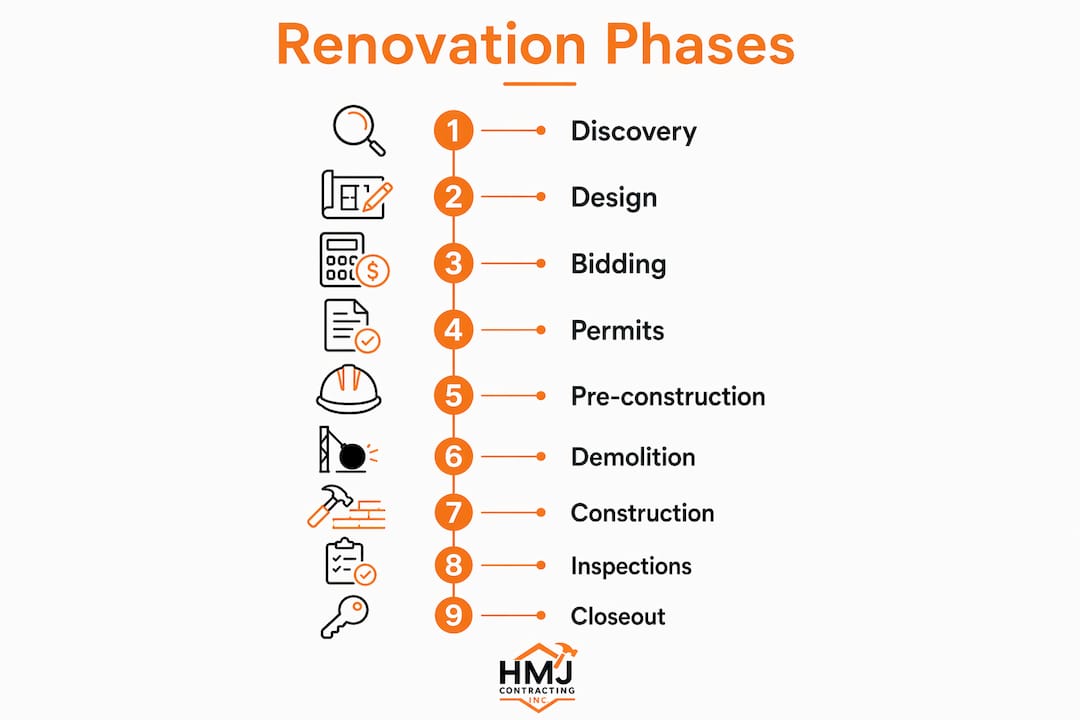
The standard 9-phase lifecycle covers discovery and scope definition, design development, contractor bidding, permit applications, pre-construction coordination, demolition, construction, inspections, and project closeout. Each phase feeds directly into the next. A weak scope definition in phase one creates change orders and disputes in phase six.

Permit timelines deserve particular attention. Simple permits take as few as 5 business days, while complex structural permits can require 6–12 weeks in high-volume jurisdictions. Ottawa homeowners working on older properties often encounter additional review requirements tied to heritage designations or hazardous material abatement, which extends timelines further. Understanding your local permit application process before construction begins prevents costly delays mid-project.
| Phase | Typical duration |
|---|---|
| Discovery and scope definition | 2–8 weeks |
| Design development | 4–12 weeks |
| Contractor bidding | 2–4 weeks |
| Permit applications | 5 days to 12 weeks |
| Pre-construction coordination | 2–4 weeks |
| Demolition and construction | 4–20 weeks (project dependent) |
| Inspections and closeout | 1–3 weeks |
Pro Tip: Never compress the design and permit phases to accelerate a start date. The time saved on the front end is almost always lost twice over during construction when scope gaps surface.
What specific responsibilities does a renovation project manager handle?
A renovation project manager coordinates every party involved in a project, including contractors, designers, architects, and material suppliers. Their job is to keep all of these moving parts aligned with the homeowner's original objectives. Without that coordination, trades work in isolation and conflicts multiply.
The core responsibilities of a project manager include:
- Scope management: Defining the full project scope upfront and controlling changes through formal change orders. Detailed documentation including change orders, material selections, and inspection approvals is the primary tool for preventing scope creep and resolving disputes.
- Budget oversight: Tracking costs against the approved budget in real time, flagging variances early, and managing contingency reserves before they are needed.
- Schedule control: Building a realistic construction schedule, sequencing trades correctly, and enforcing milestone deadlines with all parties.
- Risk management: Identifying risks during planning, such as hazardous materials in older homes, and arranging certified abatement before construction begins.
- Quality assurance: Enforcing inspection sequences and sign-offs at critical stages, particularly before concealed work is covered.
- Stakeholder communication: Maintaining a clear, consistent communication channel between the homeowner, contractors, and any regulatory bodies involved.
A project manager also handles the coordination of interior demolition sequencing, which directly affects how efficiently subsequent trades can begin their work.
Pro Tip: An independent project manager works for the homeowner, not the builder. A builder is financially motivated to complete construction efficiently. A renovation project manager acts as an independent advocate, keeping decisions neutral and aligned with your goals.
Why does professional oversight matter for renovation success?
Poor project management is the leading cause of renovation failure. Approximately 50% of renovation projects that lack structured management fail to meet their original objectives. That figure covers budget overruns, missed deadlines, quality defects, and outright project abandonment.
"Approximately 50% of renovation projects lacking structured management fail to meet objectives, underscoring the necessity for professional oversight." The cost of that failure is not just financial. It includes months of disruption, strained contractor relationships, and the expense of correcting work that was done out of sequence or without proper inspection.
The core of professional project management is controlling what the industry calls the Iron Triangle: scope, schedule, and budget. A change to any one of these three variables affects the other two. Adding a bathroom mid-project extends the schedule and increases costs. Cutting the budget forces scope reductions. A project manager manages these trade-offs consciously and proactively, rather than reacting to overruns after they occur.
Miscommunication between trades is one of the most common causes of delays. When a plumber and an electrician both need access to the same wall cavity without a coordinated schedule, work stops. A project manager prevents this by maintaining a master schedule and holding regular coordination meetings. For first-time renovators especially, this level of oversight is not optional. It is the difference between a project that finishes and one that stalls.
How to apply effective renovation project management strategies
Effective renovation project management starts before a single contractor is contacted. The following steps reflect best practices drawn from industry standards and real project experience.
-
Start project management in the planning phase. Bring a project manager in during discovery and scope definition, not after permits are pulled. Early involvement prevents the scope gaps that cause the majority of mid-project disputes.
-
Define clear success criteria. Defining success metrics aligned with long-term goals during early planning doubles project success rates. Write down what a successful project looks like: specific finishes, a completion date, a maximum budget, and any non-negotiable quality standards.
-
Maintain thorough documentation throughout. Every decision, change, and approval should be recorded in writing. Change orders protect both the homeowner and the contractor. Inspection approvals create a paper trail that matters if disputes arise later.
-
Enforce MEP rough-in sequencing. Mechanical, electrical, and plumbing rough-ins must be completed and inspected before drywall installation begins. Rushing the MEP phase causes hidden defects that are expensive to repair after walls are closed. A project manager holds the schedule at this stage regardless of pressure to move faster.
-
Coordinate communication between all stakeholders. Set a weekly update cadence with your project manager, and require written summaries of all site meetings. Verbal agreements between trades and homeowners are a primary source of scope creep.
-
Align renovation goals with long-term property objectives. A renovation that adds a bathroom may also require updated ventilation. Reviewing renovation waste reduction practices and post-renovation air quality considerations as part of planning prevents secondary issues from surfacing after completion.
For homeowners new to the process, working with a professional who understands both the construction sequence and the restoration project phases reduces the learning curve significantly.
Key takeaways
Effective renovation project management requires early planning, independent oversight, and disciplined control of scope, schedule, and budget across every phase.
| Point | Details |
|---|---|
| Start management early | Bring a project manager in during discovery to prevent scope gaps that cause most project failures. |
| Control the Iron Triangle | Manage scope, schedule, and budget as linked variables; a change to one affects the other two. |
| Document everything | Change orders and inspection approvals prevent scope creep and resolve disputes before they escalate. |
| Enforce MEP sequencing | Require inspection sign-offs before drywall to avoid costly hidden defects. |
| Independent oversight protects you | A project manager advocates for homeowner goals, distinct from the builder's financial interests. |
What I have learned after years of watching renovations succeed and fail
The projects that go wrong almost always have one thing in common: the homeowner or business owner waited too long to bring in structured oversight. They hired a contractor, trusted the process, and assumed that coordination would happen naturally. It rarely does.
The most underrated part of a project manager's role is not scheduling. It is neutrality. When a contractor recommends a shortcut, a project manager can evaluate it without a financial stake in the answer. That independence is worth more than most people realise until they are standing in a half-finished kitchen arguing over who approved a change.
I have also seen what happens when early planning phases are rushed. The permit delays, the design revisions mid-construction, the trades waiting on each other because the sequence was never mapped out. Every one of those problems was predictable. Every one of them cost more to fix than it would have cost to prevent.
The other insight I keep coming back to is documentation. Homeowners who treat paperwork as a formality end up in disputes. Homeowners who treat it as a record of every decision they made end up protected. A signed change order is not bureaucracy. It is the clearest signal that everyone understood and agreed to what was happening next.
For anyone considering a renovation in Ottawa, particularly in an older home where hazardous materials are a real possibility, the planning phase is where you protect yourself. Get the scope right. Get the permits right. And get someone in your corner whose job is to make sure the project serves your interests from start to finish.
— Jason
How Hmjcontracting supports your renovation from day one

Hmjcontracting brings full-service renovation expertise and certified abatement capabilities to Ottawa homeowners and businesses. Before construction begins, Hmjcontracting identifies and safely removes hazardous materials including asbestos, lead, and mould, ensuring your project starts on a compliant and safe foundation. Their team coordinates each phase with transparency, providing itemised quotes and clear timelines so you always know where your project stands. With a 5.0-star Google rating and hundreds of completed projects, Hmjcontracting delivers the professional oversight that keeps renovations on track. Explore their complete Ottawa renovation services to plan your next project with confidence.
FAQ
What is the role of renovation project management?
Renovation project management is the coordination of scope, schedule, and budget across all phases of a renovation, from planning through closeout. It ensures all contractors, permits, and decisions align with the homeowner's original objectives.
How many phases does a renovation project typically have?
A standard renovation follows a 9-phase lifecycle covering discovery, design, bidding, permits, pre-construction, demolition, construction, inspections, and closeout. Pre-construction phases alone can span 10–30 weeks depending on project complexity and permit timelines.
Why do so many renovation projects fail without professional management?
Approximately 50% of renovation projects lacking structured management fail to meet their objectives. The most common causes are poor scope definition, miscommunication between trades, and uncontrolled changes to budget or schedule.
What is the Iron Triangle in renovation project management?
The Iron Triangle refers to the three linked constraints of scope, schedule, and budget. A change to any one of these variables directly affects the other two, and a project manager's primary role is to manage these trade-offs consciously.
When should you hire a renovation project manager?
Hire a project manager during the discovery and scope definition phase, before design or permits begin. Early involvement prevents the planning gaps that cause the majority of mid-construction disputes and cost overruns.