
A home renovation budget step by step is the structured financial plan that maps every cost from labour to permits before a single wall comes down. Without it, Canadian homeowners routinely face cost overruns that stall projects mid-build. Whole-home renovations in Canada typically range from $100,000 to $300,000, while smaller updates run $25,000 to $75,000 depending on scope and location. The single most effective way to stay within those numbers is to build your budget before you hire anyone, not after.
How to build your home renovation budget step by step
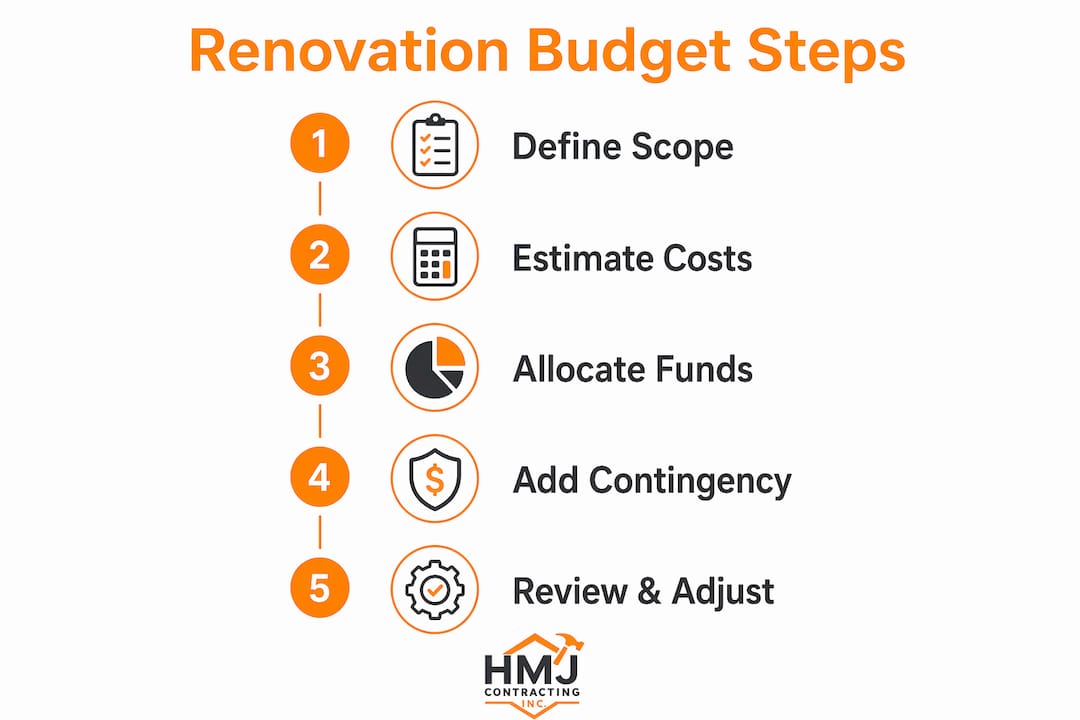
A renovation budget is not a single number. It is a structured cost breakdown across five categories: labour, materials, permits and inspections, design and project management, and contingency. Each category carries a typical percentage of your total spend, and skipping any one of them is how budgets collapse. The first step is always scope definition. You cannot price what you have not described.
Start by writing down every task the renovation involves. "Kitchen remodel" is not a scope. "Remove existing cabinetry, install new upper and lower cabinets, replace countertops, relocate sink plumbing, and add under-cabinet lighting" is a scope. That level of detail directly determines your materials list, your labour hours, and the permits you will need. A detailed renovation scope of work also protects you when comparing contractor quotes, because vague scopes produce incomparable bids.

What should your renovation scope actually include?
Scope definition separates homeowners who finish on budget from those who do not. The goal is to separate must-haves from nice-to-haves before any money changes hands.
Use this framework to build your scope:
- Structural and safety work: Foundation repairs, roof replacement, electrical panel upgrades, plumbing rerouting. These are non-negotiable and must be funded first.
- Mechanical systems: HVAC, insulation, and waterproofing. Skipping these to save money creates far larger costs later.
- Functional finishes: Flooring, cabinetry, windows, and doors. These affect daily use and resale value.
- Cosmetic upgrades: Paint, fixtures, trim, and hardware. These are the nice-to-haves you cut first if the budget tightens.
Scope also determines your permit requirements. Structural changes, electrical work, and plumbing alterations all require permits in most Canadian municipalities. Budget $500 to $3,000 for permits depending on your city and project type. Missing this line item is one of the most common errors on a first home renovation checklist.
Pro Tip: Use a printed or digital worksheet to list every task, its estimated cost, and whether it is a must-have or a nice-to-have. Reviewing this list with your contractor before signing anything prevents scope gaps that generate costly change orders.
How do you break down a renovation budget by category?
Typical budget structure allocates 40–50% to labour, 30–40% to materials, 5–15% to design and project management, 2–5% to permits and inspections, and 10–30% to contingency. These percentages shift based on project complexity and your home's age.
| Budget category | Typical percentage | Notes |
|---|---|---|
| Labour | 40–50% | General contractor fees add 10–20% on top |
| Materials | 30–40% | Includes fixtures, finishes, and structural supplies |
| Permits and inspections | 2–5% | $500–$3,000 depending on municipality |
| Design and project management | 5–15% | Architect, designer, or PM fees |
| Contingency fund | 10–30% | Higher for older or pre-1970 homes |
Contingency is the category homeowners most often underestimate. Experts recommend 10–20% for standard renovations and 20–30% for older homes or full gut renovations. Pre-1970 homes require a minimum 20% contingency because hidden issues like knob-and-tube wiring, asbestos, and lead paint are common discoveries once walls open. Contingency funds must be kept separate and untouched unless a real unexpected cost arises. Spending contingency on upgrades is how projects run out of money before completion.
Soft costs are the second most overlooked category. Temporary accommodation, storage rental, waste disposal, and provincial and federal taxes can add 10–15% to your final invoice. If your renovation forces you out of your home for six weeks, that living cost belongs in your budget. Ignoring it does not make it disappear.
Pro Tip: Add a separate line item for taxes. HST applies to labour and many materials in Ontario. On a $60,000 renovation, that is $7,800 you must account for before you start.
How do you get and compare contractor quotes fairly?
The 3-quote rule is the standard practice for renovation procurement: get at least three detailed, itemised quotes before signing anything. The critical point is that you compare itemised scopes, not totals. A quote that comes in $15,000 lower than the others is not a bargain if it excludes electrical rough-in, drywall finishing, or permit fees.
Follow these steps when collecting and evaluating quotes:
- Send every contractor the same written scope of work. This is the only way to get comparable bids.
- Ask each contractor to itemise labour and materials separately. Bundled totals hide where money is going.
- Request a list of exclusions in writing. What the quote does not cover matters as much as what it does.
- Flag any bid that is 30–50% lower than the others. Large price spreads almost always signal scope differences, not contractor generosity.
- Ask for a fixed-price contract with clearly defined exclusions. Fixed-price contracts prevent contractors from inflating costs through change orders after work begins.
Ask these questions before signing:
- Are permits included in your quote, or billed separately?
- How do you handle unforeseen conditions like mould, asbestos, or structural damage?
- What is your process for approving change orders?
- Who is on-site daily, and how do you communicate progress?
Choosing the right contractor is as important as the budget itself. Read Hmjcontracting's guide on choosing a contractor in Ottawa for a practical checklist before you commit.
How do you manage unexpected costs and avoid scope creep?
Scope creep is the gradual expansion of a project through small decisions made after the contract is signed. It is the leading cause of budget overruns on residential renovations. Scope creep happens through incremental choices, such as upgrading tile mid-project or adding a pot light that was not in the original plan. Each decision seems minor. Together, they can add tens of thousands of dollars.
Practical strategies to stay on budget:
- Freeze your design before signing. Every finish, fixture, and material selection should be confirmed before work begins. Changes after contract signing trigger change orders, which carry markup.
- Follow the correct renovation sequence. Structural and mechanical work comes first, finishes last. Doing tasks out of order forces costly rework. Painting before plumbing is fixed means painting twice.
- Track every change order in writing. Verbal approvals are unenforceable. Every scope change needs a written amendment with a cost and timeline impact.
- Use your contingency fund correctly. Reserve it for genuine surprises like hidden water damage or unexpected renovation discoveries, not for upgrades you decide you want mid-project.
- Check for energy-efficiency incentives early. Energy-efficient upgrades may qualify for government incentives that reduce your net renovation cost. Apply before work starts, not after.
Pro Tip: Set a personal change order threshold. Agree with yourself that any addition over $500 requires 24 hours of consideration before approval. This pause prevents impulse decisions that compound into serious overruns.
Key takeaways
A realistic home renovation budget requires five structured categories, a contingency fund sized to your home's age, and itemised contractor quotes compared line by line before any contract is signed.
| Point | Details |
|---|---|
| Define scope in detail | Write every task explicitly before pricing; vague scopes produce incomparable quotes. |
| Size your contingency correctly | Use 10–20% for newer homes and 20–30% for pre-1970 properties to cover hidden issues. |
| Compare quotes by scope, not price | Analyse included and excluded items line by line to avoid scope gaps and change order surprises. |
| Budget for soft costs | Add temporary living, disposal, and taxes as separate line items; these add 10–15% to your total. |
| Freeze design before signing | Confirm all finishes and fixtures before the contract is signed to prevent scope creep and cost spikes. |
What I have learned from watching renovation budgets succeed and fail
The single biggest mistake I see Canadian homeowners make is treating the contingency fund as optional. They view it as padding they can reclaim if nothing goes wrong. That thinking is backwards. The contingency fund is not a buffer for bad luck. It is the fee you pay for not knowing what is inside your walls until the work starts.
The second pattern I notice is over-investing relative to the neighbourhood. Neighbourhood resale value sets a ceiling on what your renovation can return. Spending $120,000 on a kitchen in a neighbourhood where comparable homes sell for $450,000 does not produce a $570,000 home. Check recent comparable sales before you set your total budget. This one step prevents the most common form of renovation regret I encounter.
The homeowners who finish on budget share one habit: they communicate constantly with their contractor and document everything. They do not assume. They confirm. Every change, every substitution, every delay gets written down. That discipline is not bureaucratic. It is the difference between a project that finishes and one that stalls.
— Jason
Planning a renovation in Ottawa? Hmjcontracting can help
Budgeting accurately for a renovation means accounting for every cost, including the ones hidden inside your walls. Older Ottawa homes frequently contain asbestos, lead paint, or mould that only become visible once demolition begins. Hmjcontracting provides certified abatement and renovation services with detailed, itemised quotes so you know exactly what you are paying for before work starts.

From mould remediation to demolition and junk removal, Hmjcontracting handles the full scope of pre-renovation hazard management. Their 5.0-star Google rating reflects a track record of transparent communication and clean, compliant project execution. Contact Hmjcontracting for a consultation and get a quote that fits your renovation budget from the start.
FAQ
What is a realistic budget for a first home renovation?
Kitchen renovations typically cost $15,000 to $60,000, while cosmetic refreshes run $10,000 to $30,000. Your total depends on scope, location, and how much of the work involves structural or mechanical systems.
How much contingency should I add to my renovation budget?
Standard renovations need a 10–20% contingency fund. Homes built before 1970 require a minimum of 20% to cover hidden issues like asbestos, knob-and-tube wiring, or structural damage found during demolition.
What are soft costs in a renovation budget?
Soft costs include temporary accommodation, storage, waste disposal, and taxes. These add 10–15% to your total invoice and are frequently left out of first-time renovation budgets.
How do I know if a contractor quote is too low?
A quote that is 30–50% below other bids almost always signals a scope difference, not a better deal. Ask for a full list of exclusions and compare itemised line items across all quotes before deciding.
When should I apply for renovation permits?
Apply for permits before any structural, electrical, or plumbing work begins. Most Canadian municipalities require inspections at specific project stages, and starting without a permit can result in fines or mandatory demolition of completed work.