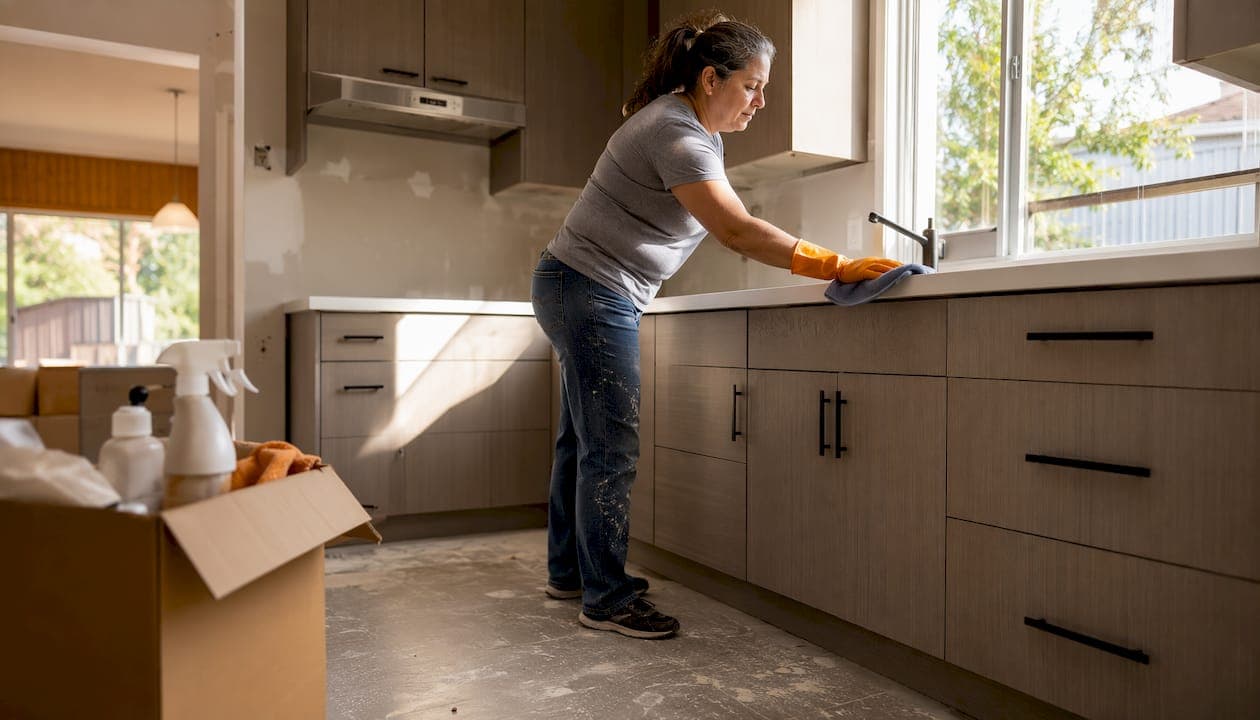
A proper post-renovation cleanout is a multi-stage, safety-focused process that goes well beyond sweeping up sawdust. It covers HEPA-filtered vacuuming of surfaces down to 0.3 microns, grout haze polishing, protective film removal from new fixtures, and thorough cleaning inside cabinetry and HVAC registers. Heavy debris removal is typically excluded unless separately contracted. When asbestos, lead, mould, or hazardous chemical residues are present, certified abatement must happen before any general cleaning begins. Skipping that step is not just risky — it may violate Ontario's Occupational Health and Safety Act.
At a glance, a complete post-renovation cleanout includes:
- Rough clean: bulk debris and construction waste removal
- Deep detail: HEPA vacuuming, microfibre surface wiping, grout haze removal, adhesive and film stripping
- HVAC register cleaning and duct-filter replacement
- Interior cabinet, drawer, and appliance cleaning
- Final touch-up pass (scheduled days later, after dust resettles)
- Certified hazardous-material abatement when required (asbestos, lead, mould)
- Post-abatement clearance testing and written reports
If your home was built or renovated before the early 1990s, start with a hazard assessment before booking any cleaning crew.
Table of Contents
- What does a post-renovation cleanout actually cover, stage by stage?
- When do you need certified hazardous-material testing before cleaning?
- How a certified abatement and cleanout is performed
- How do you choose a qualified post-renovation cleaning and abatement provider?
- What should you do before and after the cleanout?
- Your legal duties as a homeowner under Ontario's OHSA
- Key takeaways
- Why a safety-first cleanout matters more than most homeowners realise
- Hmjcontracting's certified post-renovation cleanout and abatement services in Ottawa
- Useful sources and where to learn more
What does a post-renovation cleanout actually cover, stage by stage?
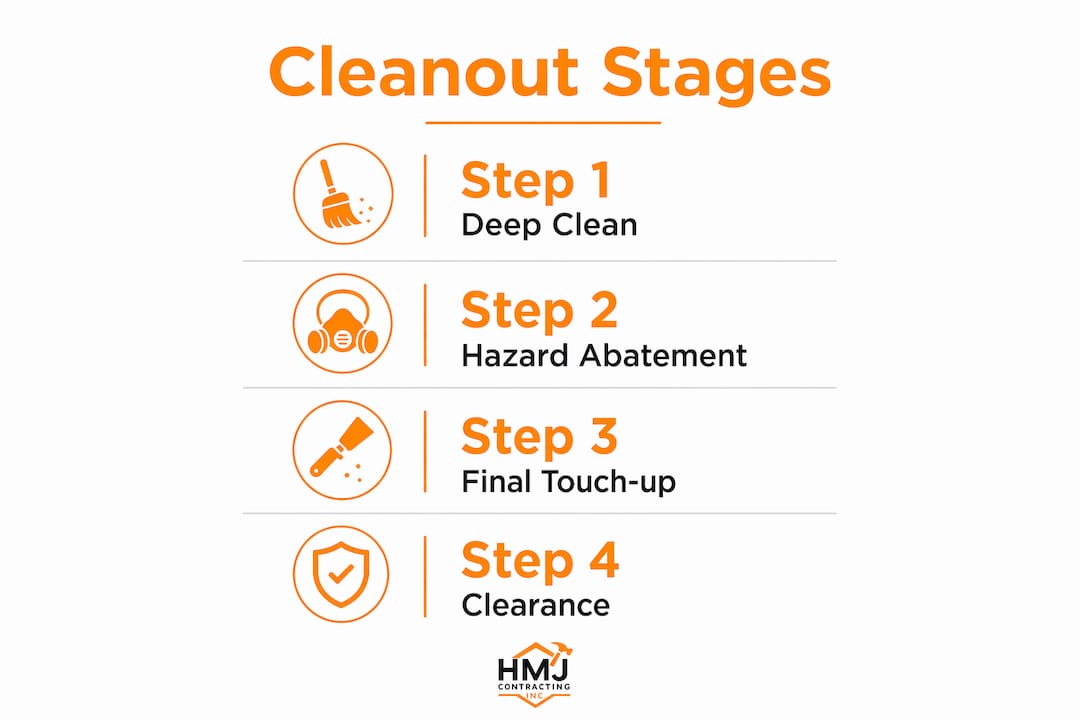
Post-construction cleaning follows three distinct phases because construction dust continues to settle for days after work finishes. One pass is rarely enough.
Stage 1 — Rough clean
- Remove bulk debris, leftover materials, and packaging
- Sweep and bag construction waste for proper disposal
- Clear staging areas so detail crews can access all surfaces
Stage 2 — Deep detail clean
- HEPA-filtered vacuuming of all walls, ceilings, floors, and trim
- Microfibre dry-wipe of every horizontal and vertical surface
- Grout haze removal from tile and stone
- Adhesive and protective film stripping from windows, appliances, and fixtures
- Interior cleaning of all cabinets, drawers, and shelving
- Cleaning light fixtures, switch plates, and door hardware
- HVAC register wipe-down and vent cover removal for cleaning
Stage 3 — Final touch-up
- Spot-check mirrors, glass, and countertops
- Re-wipe any surfaces where dust has resettled
- Final floor buff or mop
Room-specific tasks to confirm on your quote:
| Area | Key tasks |
|---|---|
| Kitchen | Inside cabinets and drawers, appliance film removal, grout scrubbing, chrome polishing |
| Bathrooms | Grout haze removal, tile sanitising, toilet and tub deep clean, drywall dust from tiles |
| Living areas | Light fixture detailing, window tracks, baseboard wipe-down, vent cleaning |
| HVAC/vents | Register removal and wash, filter replacement, duct-opening wipe |
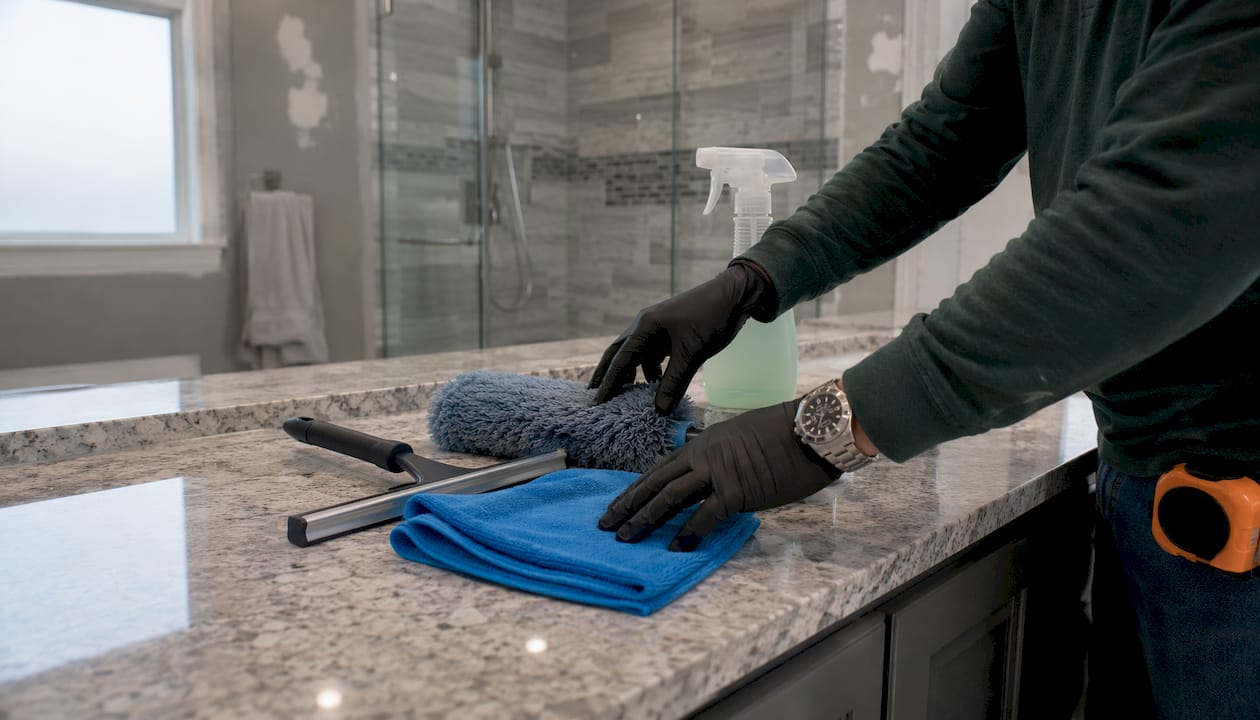
Pro Tip: Schedule the final touch-up pass at least 48–72 hours after the deep clean. Fine particulates keep settling, and a second visit catches what the first pass cannot.
A standard post-build clean typically excludes heavy debris hauling, hazardous-material remediation, and air-duct cleaning unless those are separately contracted. Confirm each item in writing before work starts.
When do you need certified hazardous-material testing before cleaning?
Standard cleaning crews are legally prohibited from handling designated hazardous substances like asbestos under Ontario Regulation 278/05. Sending an uncertified crew into a space with disturbed asbestos or lead does not just create a health risk — it creates legal liability.
Triggers that make certified testing mandatory:
- Home built or renovated before the early 1990s
- Visible suspect materials: textured ceilings (popcorn), vinyl floor tile backing, old pipe insulation, vermiculite
- Water-damaged areas with visible or suspected mould growth
- Renovations that opened wall cavities, removed old flooring, or disturbed original insulation
- Any demolition work on pre-1990s structures
Required steps before cleaning proceeds:
- Order a bulk-sampling assessment from a licensed inspector
- Do not allow general cleaners to bag or handle suspect materials
- Require a written abatement plan, containment protocol, and clearance report before re-occupancy
- Confirm the abatement contractor holds the appropriate provincial certifications
Homeowners can be classified as "constructors" or employers under provincial occupational health and safety guidance when a renovation turns a home into a work site. That classification carries due-diligence obligations for safe work areas and lawful hazardous-waste handling — not just for hired crews, but for the homeowner directing the work.
Certified abatement and post-clean clearance testing are the only reliable ways to confirm that hazardous fibres or residues have been removed safely. A visual inspection alone is not sufficient.
How a certified abatement and cleanout is performed
The sequence every qualified contractor should follow:
- Pre-assessment and bulk sampling by a licensed inspector
- Containment setup: poly sheeting, negative-air machines, sealed decontamination zones
- Abatement: removal of designated substances in sealed, labelled waste bags
- Rough clean: bulk debris cleared from the work area
- Deep detail clean: HEPA vacuuming and surface wiping throughout
- Clearance testing: independent air sampling or surface wipe tests
- Final touch-up after clearance results are confirmed
Equipment a qualified crew brings:
- HEPA-filtered vacuums (captures particulates to 0.3 microns)
- Negative-air machines and air scrubbers
- Poly sheeting and zipper-door containment barriers
- Sealed, labelled hazardous-waste bags and containers
- Full PPE: respirators (minimum N100), disposable coveralls, gloves, boot covers
Typical project timeline
| Project size | Pre-assessment | Abatement | Cleaning passes | Clearance turnaround |
|---|---|---|---|---|
| Small (1–2 rooms) | 1 day | 1–2 days | 2 passes | 1–3 business days |
| Medium (half-house) | 1–2 days | 2–4 days | 2–3 passes | 2–4 business days |
| Large (full house) | 2–3 days | 4–7 days | 3+ passes | 3–5 business days |
Hazardous renovation waste — asbestos debris, lead-containing materials, mould-contaminated drywall, and chemical solvents — has legally required disposal pathways in Ontario. The City of Ottawa's solid waste by-law restricts construction and demolition waste disposal routes. Bagging these materials in regular municipal trash is not permitted and can result in significant fines.
How do you choose a qualified post-renovation cleaning and abatement provider?
Questions to ask every contractor before signing:
- What certifications do you hold for asbestos, lead, and mould abatement?
- Can you provide proof of WSIB coverage and liability insurance?
- Do you conduct post-abatement clearance testing, and will you provide written lab reports?
- What HEPA equipment will you use, and what are the filter specifications?
- Will you provide an itemised scope of work with included, optional, and excluded tasks listed separately?
Red flags to watch for:
- Scope described only as "clean up" with no methods or equipment listed
- No HEPA vacuums on the equipment list
- Willingness to dispose of suspect materials in regular trash
- Refusal to provide references or documented project history
- No mention of clearance testing or post-abatement reporting
When comparing quotes, check scope equivalence first. A lower price that omits the final touch-up pass, clearance testing, or HVAC register cleaning is not a better deal. Ask specifically whether a follow-up visit is included if dust resettles after the initial clean. For hidden hazards in older homes, a contractor with documented abatement experience is worth the extra scrutiny.
What should you do before and after the cleanout?
Before the crew arrives:
- Secure valuables and move fragile items out of work areas
- Provide keys, floor plans, and access to all rooms including mechanical spaces
- Inform the contractor of any occupants with respiratory sensitivities, allergies, or pets
- Arrange temporary relocation if abatement or heavy dust exposure is expected
- Confirm the HVAC system will be shut down during cleaning to prevent dust recirculation
During the work:
- Stay out of containment areas entirely
- Keep children and pets away from the property
- Expect temporary HVAC shutdowns and possible filter changes mid-process
After the cleanout is complete:
- Request all clearance reports and air-test results in writing before re-entering
- Change HVAC filters immediately after the final clean
- Allow the recommended airing-out period before moving back in
- Inspect inside cabinets, behind appliances, and at vent openings for residual dust
Pro Tip: Photograph problem areas before and after the cleanout, and keep all itemised invoices and clearance certificates. These documents are valuable for future home disclosure, warranty claims, and resale.
Your legal duties as a homeowner under Ontario's OHSA
Ontario's Occupational Health and Safety Act (OHSA) does not apply only to commercial job sites. When you hire contractors to renovate your home, your property can become a regulated work site, and you may carry legal responsibilities as the person directing that work.
Under OHSA and related provincial guidance, a homeowner who engages contractors and directs the scope of work can be treated as a "constructor." That means you have a duty to verify that the contractors you hire are competent, that hazardous substances are identified before work begins, and that waste is handled and disposed of lawfully. Relying on a contractor's verbal assurance is not sufficient due diligence. For homeowner safety obligations during renovations, written contracts, proof of certification, and documented clearance testing are the practical tools that demonstrate you met your duty of care.
Practically, this means requiring WSIB clearance certificates, liability insurance documentation, and written abatement plans from every contractor who handles designated substances on your property.
Key takeaways
A complete post-renovation cleanout requires three staged passes, certified abatement for any hazardous materials, HEPA-filtered equipment, and written clearance documentation before re-occupancy.
| Point | Details |
|---|---|
| Three-stage process | Rough clean, deep detail, and a final touch-up pass after dust resettles are all required. |
| HEPA equipment is mandatory | Residential vacuums cannot capture construction particulates down to 0.3 microns; only HEPA-filtered equipment can. |
| Abatement before cleaning | In homes built before the early 1990s, certified hazardous-material testing must precede any general cleaning. |
| Homeowner legal duty | Under Ontario's OHSA framework, homeowners directing renovation work carry due-diligence obligations for safe waste handling. |
| Hmjcontracting | Ottawa homeowners with pre-1990s properties or suspect materials should contact a licensed abatement specialist for an assessment before booking any cleaning crew. |
Immediate next steps:
- Assess your home's age and renovation history for potential hazardous materials
- Request itemised quotes that list included, optional, and excluded tasks
- Confirm HEPA equipment and clearance testing are part of the scope
- Schedule an HVAC filter change for immediately after the final clean
- Retain all invoices, clearance certificates, and lab reports
Why a safety-first cleanout matters more than most homeowners realise
Post-renovation cleaning is consistently treated as the last item on a long list, which is exactly when corners get cut. Construction dust is not just a nuisance. It contains respirable silica and fine particulates that linger in HVAC systems and inside cabinetry long after the renovation crew has left. The health consequences for occupants with asthma, young children, or compromised immune systems are real and documented.
What concerns me more, though, is the hazardous-material gap. Homeowners routinely book general cleaning crews for post-renovation work without first confirming whether asbestos, lead, or mould was disturbed during the project. A general cleaner vacuuming up asbestos-containing debris is not just ineffective — it actively spreads fibres that should have been contained and disposed of through certified channels. The clearance report is not a formality. It is the only objective confirmation that the space is safe to occupy.
Transparent documentation, itemised scopes, and written clearance certificates protect you legally and practically. Keep every document.
Hmjcontracting's certified post-renovation cleanout and abatement services in Ottawa
For Ottawa homeowners dealing with older properties or renovation projects that disturbed suspect materials, the gap between a general cleaning crew and a certified abatement specialist is significant. Hmjcontracting brings both under one roof: licensed abatement for asbestos, lead, and mould, combined with a thorough post-renovation cleanout using HEPA-filtered equipment and negative-air containment.

Every project starts with a written assessment and an itemised scope of work. Hmjcontracting carries full WSIB coverage and liability insurance, provides post-abatement clearance testing with written lab reports, and has a long documented project history in the Ottawa area. There are no vague "clean-up" line items — you see exactly what is included before work begins.
If your home is pre-1990s or your renovation uncovered anything suspect, request a free assessment from Hmjcontracting's certified abatement team before any cleaning crew sets foot in the space.
Useful sources and where to learn more
Regulatory and legal references:
- Ontario Regulation 278/05 — Designated Substances: The governing regulation for asbestos and other designated substances in Ontario workplaces and renovation sites.
- WorkSafeNB — Residential Construction and Renovation Projects: Provincial guidance on homeowner and constructor duties under occupational health and safety frameworks.
- City of Ottawa Solid Waste Services By-law No. 2024–453: Defines permitted disposal routes for construction and demolition waste in Ottawa; confirms that hazardous renovation materials cannot go into municipal trash.
- Ontario.ca — Achieve Compliance on Construction Sites: Hygiene: Details minimum hygiene and safety standards under O. Reg. 213/91 for construction projects in Ontario.
Further reading for Ottawa homeowners:
- Renovation waste reduction best practices: Practical guidance on managing and reducing construction and demolition waste lawfully.
- Signs you may need asbestos removal before renovating: A practical checklist to help you decide whether to order testing before any cleaning or renovation work begins.
This article is general information, not legal or professional advice. Confirm current regulations and your specific obligations with Ontario's Ministry of Labour or a qualified licensed abatement professional before proceeding with any renovation or cleanout work.